
Clinical supervision management software is the tool that behavioral health practices use to track supervision hours, review and co-sign clinical notes, and keep prelicensed clinicians moving toward licensure without relying on scattered spreadsheets. For solo clinicians this might mean one supervisor and a handful of supervisees. For growing group practices, it often means dozens of clinicians, multiple state licensing boards, and a daily risk that a missed signature or an untracked hour quietly delays someone's career.
In short: clinical supervision management software centralizes hour tracking, note co-signature, and board-ready documentation in one system, so supervisors and owners can see supervision status across the entire practice without chasing files or staff.

Clinical supervision management software gives supervisors a real-time view of hours, notes, and sign-offs.
What Is Clinical Supervision Management Software?
Clinical supervision management software is a digital system built specifically for behavioral health practices to manage the supervisory relationship between a licensed supervisor and a prelicensed clinician. Instead of logging hours on paper or in a shared spreadsheet, the supervisor and supervisee work inside a shared platform that records direct and indirect hours, tracks note review status, and flags anything that still needs a signature.
Clinical supervision, broadly defined, is the formal relationship through which a licensed professional oversees the clinical work of a less experienced practitioner. In behavioral health, that oversight is not optional. Most states require a specific number of supervised hours, a documented ratio of individual to group supervision, and signed evidence of review before a clinician can sit for licensure. Consequently, the software that manages this process has to understand licensing rules, not just store files.
Why Behavioral Health Practices Need Supervision Tracking Tools
Practices that still track supervision manually tend to discover problems only after they have already caused harm. For example, a supervisor might realize at renewal time that three months of group supervision hours were never logged correctly, or that a supervisee's notes sat unsigned for weeks. As a result, licensure timelines slip and billing gets held up, because many payers require supervisory sign-off before a claim for a prelicensed clinician can go out.
According to the U.S. Bureau of Labor Statistics, employment of substance abuse, behavioral disorder, and mental health counselors is projected to grow faster than average through the decade, which means more practices will be training and supervising new clinicians at once. That growth makes manual tracking even riskier. Supervision tracking tools solve this by surfacing gaps automatically, before they become a compliance or revenue problem. For a deeper look at how hour requirements differ across jurisdictions, this state-by-state clinical supervision tracking guide breaks down the variation practice owners run into most often.
Key Features of Clinical Supervision Management Software
Not every system that claims to handle supervision actually does it well. In particular, practices should evaluate whether a platform can apply different state hour requirements automatically, because a one-size-fits-all hour counter is not enough once a practice supervises clinicians in more than one state.
- State-specific hour tracking: Automatically applies each state's direct, indirect, and group supervision ratios.
- Note co-signature workflows: Routes notes to the correct supervisor and flags anything still awaiting sign-off.
- Board-ready exports: Compiles signed hours and documentation into formats licensing boards accept.
- Billing integration: Connects supervision status to supervisory billing so claims do not go out before review is complete.
- Real-time alerts: Notifies supervisors and owners when hours, signatures, or renewals are at risk of lapsing.
This specific question, can supervision software track hours by state for clinical supervisors, comes up constantly during vendor evaluations, and it is usually the feature that separates a general EHR add-on from purpose-built supervision software.
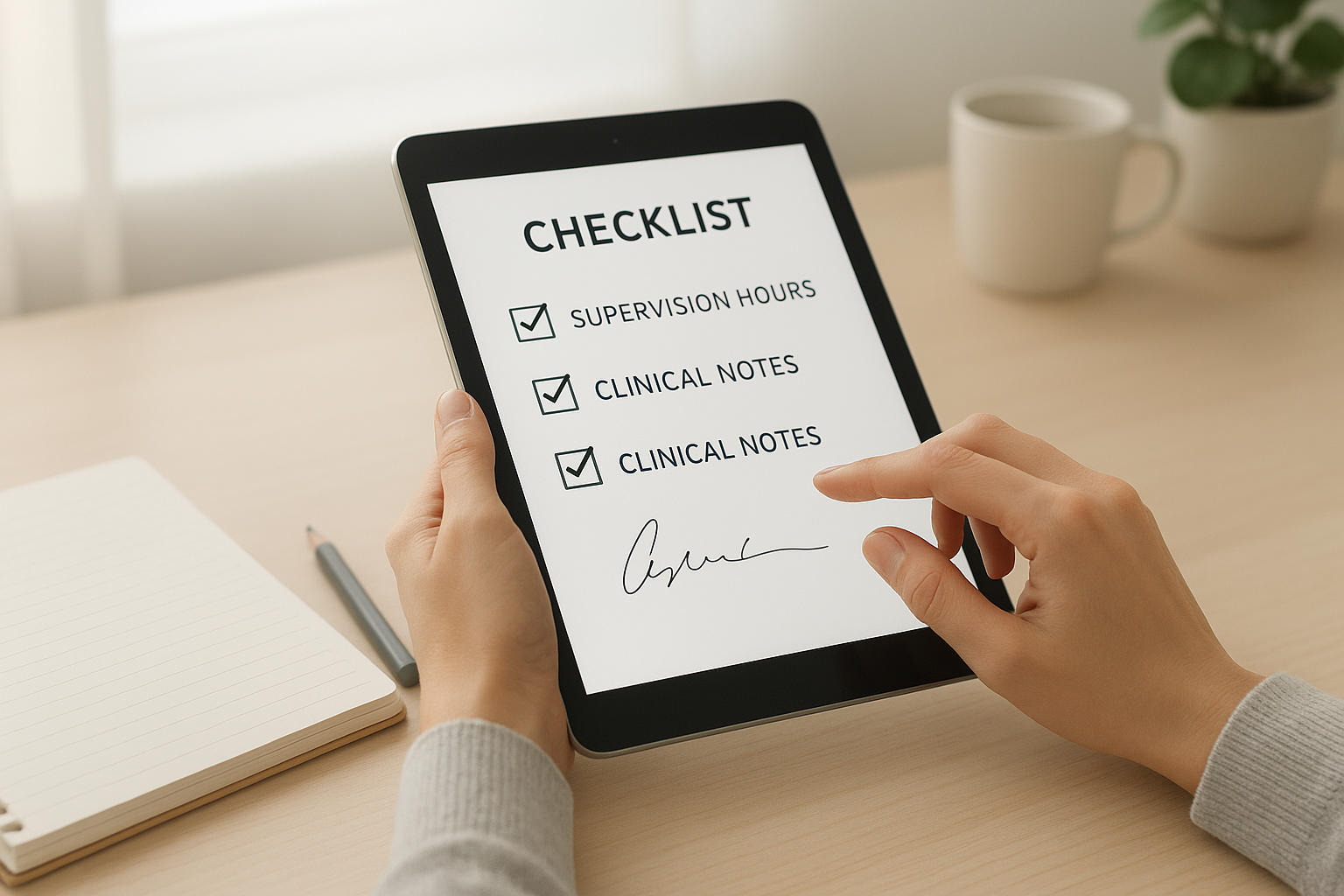
A clear checklist view helps supervisors catch gaps before they delay licensure or billing.
Clinical Supervision Software vs. Manual Spreadsheets
Spreadsheets feel manageable when a practice has one or two supervisees. However, once a group practice grows past five or six prelicensed clinicians, manual tracking tends to break down quietly rather than dramatically. Hours get entered inconsistently, files live on different computers, and nobody notices a missing co-signature until a note has already aged past the point of easy correction.
In contrast, dedicated software keeps every supervisee's record in one place, applies licensing rules consistently, and alerts the right person the moment something needs attention. This is similar to how structured documentation tools improve note consistency; the progress notes software behavioral health teams trust follows the same logic of replacing ad-hoc habits with a consistent, auditable workflow.
How to Choose and Implement Clinical Supervision Management Software
Selecting the right platform is easier when practices follow a clear sequence rather than comparing feature lists at random. The steps below reflect how most behavioral health group practices successfully move from manual tracking to a centralized system.
- Audit current supervision tracking. List every supervisee, their state requirements, and how hours and co-signatures are currently logged today.
- Map state-specific requirements. Document each state's required hour ratios, since practices with clinicians across state lines need software that applies different rules automatically.
- Shortlist software with billing integration. Favor platforms that connect supervision records to claims, so unsigned notes cannot trigger billing prematurely.
- Migrate historical hour logs. Work with onboarding staff to import existing hours and signed notes so no supervisee loses progress during the switch.
- Train supervisors and run a live cycle. Walk every supervisor through the workflow, then run one full documentation and billing cycle to confirm accuracy.
Practices that are also evaluating documentation tools alongside supervision software often find it useful to review related workflows, such as treatment plan software for behavioral health practices, since treatment plans and supervision notes frequently require the same sign-off chain.
How TuskaMind Supports Clinical Supervision Management
TuskaMind was built inside a live Colorado group practice supervising prelicensed clinicians alongside roughly 70 to 100 daily insurance claims, so supervision tracking was designed around real operational pressure rather than theory. The platform tracks supervision hours by state, routes notes for co-signature, and connects supervisory billing directly to the revenue cycle, so a missing sign-off cannot quietly turn into a denied claim weeks later.
Owners and supervisors see supervision status on the same dashboard as billing, documentation, and client balances, which means nobody has to ask the billing team whether a supervisee's hours are current. Practices that want a closer look at how this works in practice can visit the TuskaMind learning center or explore the platform directly at tuskamind.com.

Centralized reporting lets supervisors, billers, and owners stay aligned without separate systems.
Compliance and Data Security Considerations
Supervision records contain sensitive clinical information, so any platform handling them must meet HIPAA and HITECH standards, including signed business associate agreements and audit trails. The U.S. Department of Health and Human Services outlines these requirements in detail, and practices should confirm a vendor's safeguards before migrating any records. In addition, role-based access matters: a supervisor should only see their own supervisees, while owners and compliance staff retain a practice-wide view.
Above all, practices should ask vendors directly how supervision data is isolated between locations or departments if the practice operates more than one site. This prevents accidental cross-visibility between teams that should remain separate for privacy reasons.
Frequently Asked Questions
What is clinical supervision management software?
Clinical supervision management software is a digital system that tracks supervision hours, manages note review and co-signature, and keeps board-ready records for prelicensed clinicians. It replaces spreadsheets and paper logs with a centralized, auditable workflow.
How does clinical supervision management software track hours by state?
It applies state-specific licensing board rules to each supervisee's logged hours, separating direct, indirect, and group supervision categories automatically. This keeps totals accurate even when a practice supervises clinicians across multiple states.
Why do behavioral health practices need supervision software instead of spreadsheets?
Spreadsheets do not flag missing co-signatures, expiring hours, or documentation gaps until it is too late. Software surfaces these issues in real time, which protects both the supervisor's license and the practice's billing.
How much does clinical supervision management software cost?
Pricing varies by vendor and typically depends on clinician headcount, whether billing and EHR tools are bundled, and implementation support. Most behavioral health platforms price per provider per month rather than a flat practice fee.
How long does it take to implement supervision tracking software?
Basic supervision tracking can go live within a few days, while full onboarding with historical hour migration and billing integration usually takes two to six weeks. Timelines depend on practice size and data cleanup needs.
What is the difference between supervision software and a general EHR?
A general EHR stores clinical records but rarely tracks licensure-specific supervision hours or co-signature workflows. Purpose-built clinical supervision management software connects documentation, supervision, and billing in one place.
Can supervision software help with board-ready documentation?
Yes, it compiles signed notes, hour logs, and supervisor attestations into exportable records formatted for licensing board submission. This reduces last-minute scrambling when a supervisee applies for licensure.
What common mistakes happen when practices track supervision hours manually?
Common mistakes include double-counting hours, missing a required co-signature deadline, and losing records when staff turn over. These errors can delay a clinician's licensure timeline by months.
Does clinical supervision management software work for group practices with multiple supervisors?
Yes, enterprise-grade platforms assign role-based permissions so each supervisor sees only their supervisees while owners retain a practice-wide view. This scales from a handful of supervisees to dozens across multiple locations.
How does supervisory billing relate to clinical supervision management?
Supervisory billing requires the supervising clinician's credentials to be attached to claims for prelicensed staff. Software that connects supervision records directly to the billing workflow prevents claims from going out before required sign-offs happen.
What features should I look for before buying supervision software?
Look for state-specific hour tracking, note co-signature workflows, automated alerts for gaps, and integration with billing and documentation. Reporting that exports board-ready summaries is also essential.
Is clinical supervision management software HIPAA compliant?
Reputable platforms are built on HIPAA and HITECH-compliant architecture, including audit trails, role-based access, and signed business associate agreements. Practices should confirm these safeguards before migrating supervision records.
How does AI help with clinical supervision workflows?
Embedded AI can flag missing fields in supervision notes, suggest documentation language, and alert supervisors when a co-signature or hour log is overdue. This reduces administrative time spent chasing paperwork.
Conclusion
Clinical supervision management software turns a manual, error-prone process into a transparent system that protects licensure timelines, supervisor accountability, and practice revenue at the same time. As behavioral health practices grow and the workforce supervising new clinicians expands, relying on spreadsheets simply stops scaling. Instead, a centralized platform that connects supervision hours, note co-signature, and supervisory billing gives owners and supervisors one clear view of what needs attention next. For practices ready to move past manual tracking, exploring a purpose-built solution like TuskaMind, or reviewing further resources such as the TuskaMind learning center, is a reasonable next step toward a more proactive supervision workflow.