
State-by-state clinical supervision tracking is the process behavioral health practices use to monitor supervision hours, co-signature requirements, and licensing board rules for every prelicensed clinician, regardless of which state they practice in. For a group practice owner overseeing associates working toward independent licensure, this is not optional bookkeeping — it is the backbone of board compliance and clean insurance billing. As a result, practices that employ clinicians across multiple states, or that support remote associates, often struggle to keep every supervision record accurate and audit-ready.
In addition, the stakes are higher than most owners realize. Because licensing boards rarely accept "we lost track" as an explanation, a single missed co-signature or miscounted hour can delay a clinician's licensure application by months. This guide explains what state-by-state clinical supervision tracking involves, why it is so hard to manage manually, and how a centralized system changes the equation.

State-by-state clinical supervision tracking starts with accurate, consistent session documentation.
What Is State-by-State Clinical Supervision Tracking?
State-by-state clinical supervision tracking is the ongoing process of logging supervised hours, confirming supervisor qualifications, and documenting co-signatures according to the specific licensing board rules that apply to each clinician's state. Because no two boards share identical requirements, practices need a system that reflects each jurisdiction individually rather than a single blanket policy.
Specifically, this tracking typically covers four components: total hours completed, the ratio of direct to indirect supervision, the supervisor's credentials and board approval status, and the documentation format a board expects when a clinician applies for licensure. For example, a counselor working toward an LPC in one state may need a different hour split than an associate pursuing an LMFT a few states away. Consequently, a practice employing clinicians in several states is effectively managing several different compliance calendars at once.
Why Supervision Hour Requirements Change by State
Licensing boards for counseling, social work, and marriage and family therapy operate independently in each state, so there is no federal standard governing supervised hours. According to the Association of Social Work Boards, required supervised experience hours for clinical licensure can range from roughly 1,000 hours to well over 4,000 hours depending on the license type and jurisdiction. Similarly, some states require a minimum number of individual supervision sessions per month, while others focus on a cumulative hour total without a strict session cadence.
This variation matters even more as behavioral health telehealth expands clinicians' reach across state lines. The Health Resources and Services Administration has long tracked growing demand for behavioral health providers relative to available supervised training capacity, underscoring why practices can't treat supervision as an afterthought. In practice, that means a clinician licensed to practice in one state but supervised by someone credentialed in another can trigger extra scrutiny from a board reviewing the application.
The Challenges of Multi-State Supervision Oversight
Most practices start out tracking supervision hours in a spreadsheet, and for a single clinician, that can work well enough. However, as a practice grows past a handful of associates, the spreadsheet approach breaks down quickly. Spreadsheets don't flag an approaching deadline, don't connect to the note a supervisor still needs to sign, and don't distinguish between a board that requires monthly individual supervision and one that allows group formats.
Furthermore, unsigned notes create a ripple effect beyond supervision compliance alone. Many payers require documented supervisory oversight before they will reimburse claims submitted for services a prelicensed clinician provided, according to common commercial payer credentialing policies referenced by the clinical supervision literature. As a result, a missed co-signature doesn't just sit as a compliance gap; it can directly delay revenue the practice has already earned.
How to Build a State-by-State Clinical Supervision Tracking Process
Building a reliable process doesn't require reinventing anything from scratch. Instead, it means structuring the work so nothing depends on memory. The following steps outline a practical approach practices can adapt regardless of size.
- Audit each clinician's state licensing board requirements. Start by pulling the specific supervision hour requirements, ratio rules, and documentation standards from the licensing board governing each prelicensed clinician's practice location, since requirements can differ even between neighboring states.
- Centralize hour logs and co-signature workflows. Move every supervision hour log, session note, and co-signature requirement into one shared system so administrators and supervisors can see outstanding items without emailing spreadsheets back and forth.
- Set automated alerts for approaching deadlines. Configure alerts that flag clinicians nearing licensure eligibility, unsigned notes awaiting supervisor review, or supervision ratios falling out of compliance before a board audit catches the gap.
- Schedule regular compliance audits. Review supervision records on a recurring basis, comparing logged hours against board-specific requirements and correcting discrepancies while they're still small and easy to document.

A centralized dashboard view makes state-by-state clinical supervision tracking visible at a glance.
Key Features to Look for in Supervision Tracking Software
Not every behavioral health EHR, or electronic health record system used to store clinical documentation, handles supervision well. Therefore, practices evaluating options should look for a few specific capabilities rather than assuming any EHR covers this ground. First, the system should let administrators set hour and ratio rules per clinician, not just per practice, since a group practice often has associates pursuing different license types in different states.
Second, co-signature workflows should connect directly to documentation, so a supervisor reviewing a note can sign it in the same place it was written rather than switching tools. Third, alerts should surface automatically on a practice-wide dashboard, instead of requiring someone to run a manual report. Finally, because supervision gaps can affect billing, the strongest systems link supervision status to claims so a biller can see at a glance whether a service is ready to submit.
How TuskaMind Supports State-by-State Clinical Supervision Tracking
TuskaMind was built inside a live Colorado group practice supporting roughly 50 clinicians and contractors and processing approximately 70 to 100 insurance claims per day, so its supervision tools reflect operational reality rather than theory. Within that environment, supervision management includes hour tracking, note review and co-signature, and board-ready supervision records designed to hold up under audit. You can see the broader platform, including supervision and documentation tools, on the TuskaMind features overview.
Above all, supervision data doesn't sit in isolation. Because TuskaMind connects supervision status to documentation and claims, an unsigned note that could hold up billing shows up as an alert before it becomes a denied claim. In addition, the platform's HIPAA and HITECH-aligned architecture, detailed on the security page, keeps supervision records and audit trails protected as they move between supervisors, billers, and administrators. Practices interested in early access can also review the Pilot Partner Program for hands-on onboarding support. For a broader look at how the system fits together, the TuskaMind platform overview is a useful starting point.
Common Mistakes in Clinical Supervision Compliance
Even well-run practices fall into predictable traps. For instance, many rely on a spreadsheet that one person updates manually, which works until that person is out sick during a licensure application deadline. Similarly, practices sometimes track total hours without separating direct and indirect categories, only to discover during an application review that the mix doesn't meet board requirements.
Another frequent mistake involves telehealth supervision. While many boards now accept virtual supervision sessions, documentation standards for telehealth sometimes differ from in-person requirements. Consequently, practices should confirm each board's current telehealth policy rather than assuming every state treats virtual supervision identically. Finally, some practices wait until a clinician is ready to apply for licensure before reviewing their full supervision history, which leaves little room to fix gaps discovered late.
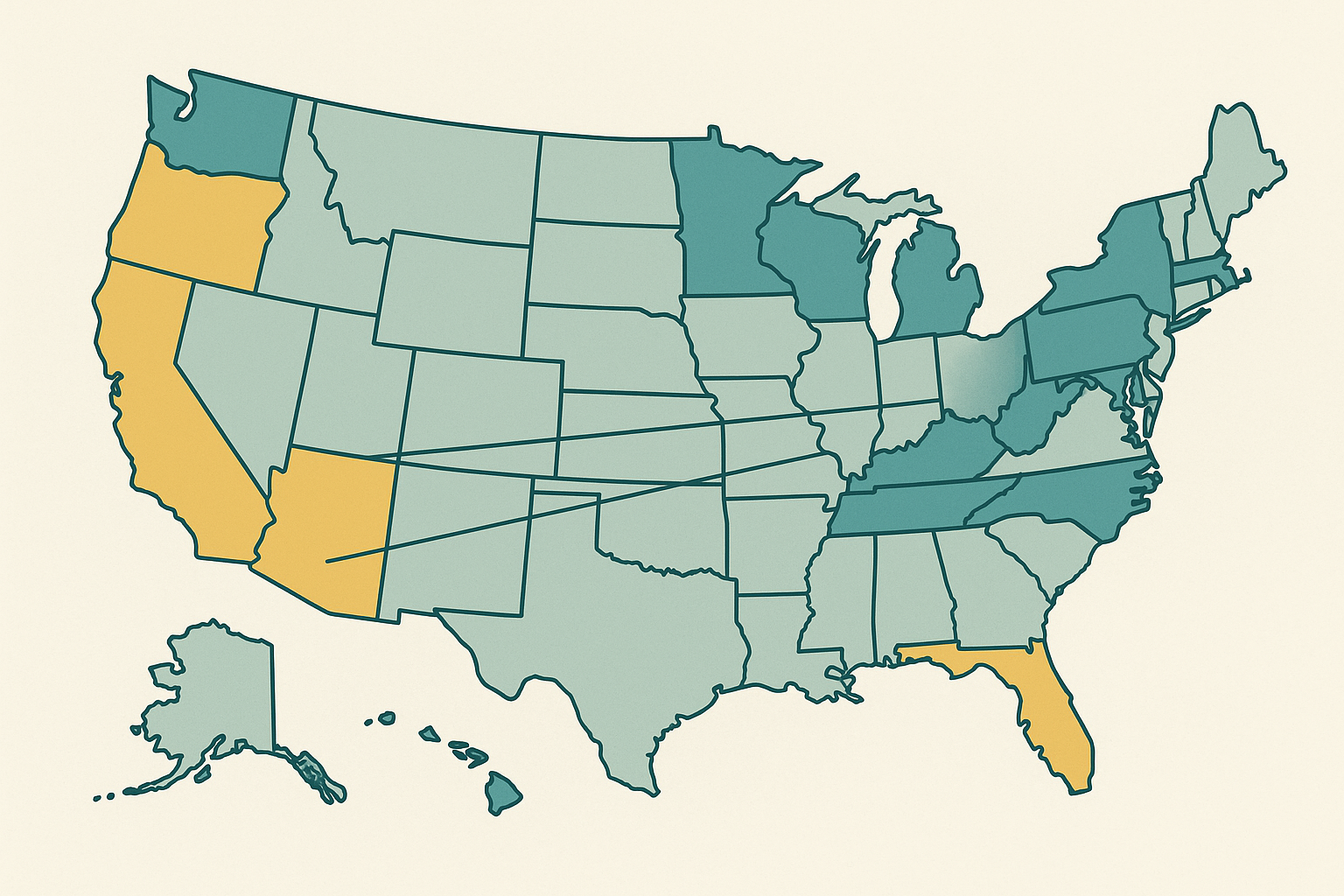
Licensing board rules vary enough across the map that manual tracking quickly becomes unmanageable.
Frequently Asked Questions About State-by-State Clinical Supervision Tracking
What is state-by-state clinical supervision tracking?
State-by-state clinical supervision tracking is the process of monitoring supervision hours, co-signature requirements, and licensing board rules for prelicensed clinicians based on the specific state governing their license. It matters because requirements for hour counts, ratios, and documentation differ widely from one board to the next.
Why do supervision hour requirements vary by state?
Each state licensing board sets its own rules for counseling, social work, and marriage and family therapy licensure, so hour totals, direct-to-indirect ratios, and supervisor qualifications differ by jurisdiction. There is no single national standard that practices can rely on.
How many supervision hours are typically required for licensure?
Requirements commonly range from around 1,000 to over 4,000 supervised hours depending on the license type and state. Because these totals shift by board, practices should confirm current requirements directly with each relevant licensing authority.
What happens if supervision hours aren't tracked properly?
Poorly tracked hours can delay a clinician's licensure application, trigger board audits, or create billing problems when supervisory oversight can't be documented. In some cases, inaccurate records can even affect a claim's reimbursement eligibility.
Can one platform track supervision hours across multiple state boards?
Yes, a centralized behavioral health platform can log hours, co-signatures, and board-specific milestones for clinicians in different states within one system. This removes the need for separate spreadsheets or manual cross-checking against each board's rules.
How does TuskaMind support state-by-state clinical supervision tracking?
TuskaMind centralizes supervision hour logs, note co-signature workflows, and compliance alerts inside one practice-wide dashboard, built from the operational experience of running a real multi-clinician group practice. Owners and supervisors can see exactly where each clinician stands without chasing spreadsheets.
What's the difference between supervision tracking and co-signature workflows?
Supervision tracking refers to the ongoing tally of hours, ratios, and milestones required for licensure, while co-signature workflows involve a supervisor reviewing and signing individual clinical notes. Both are connected, since unsigned notes often hold up billing and documentation readiness.
How much does supervision tracking software cost?
Costs vary depending on whether a practice uses a standalone tool or a built-in module within a broader behavioral health platform. Bundled systems can reduce overall software spend compared to paying for separate supervision, billing, and documentation tools.
How long does it take to set up a supervision tracking system?
Implementation timelines depend on practice size, but most group practices can migrate existing supervision records and configure alerts within a few weeks. White-glove onboarding and migration assistance typically shortens this timeline considerably.
What are common mistakes practices make when tracking supervision hours?
Common mistakes include relying on spreadsheets that fall out of date, failing to separate direct and indirect hour categories, and missing board-specific documentation formats. Many practices also discover gaps only after a clinician applies for licensure.
Do telehealth supervision sessions count the same as in-person sessions?
Many state boards now accept telehealth supervision sessions, but rules on format, documentation, and allowable ratios still vary. Practices should verify each board's current telehealth supervision policy before relying on it for licensure hours.
How does supervision tracking affect insurance billing and claims?
Many payers require documented supervisory oversight before reimbursing services delivered by prelicensed clinicians, so incomplete supervision records can delay or deny claims. Connecting supervision tracking to billing workflows helps prevent revenue from stalling.
What documentation do licensing boards require for supervision?
Boards generally require logs of supervised hours, supervisor credentials, session notes, and periodic evaluations signed by the supervisor of record. Exact formats and submission requirements differ, so practices should keep records organized by state from the start.
How often should supervision records be audited?
Reviewing supervision records monthly, or at minimum quarterly, helps catch discrepancies while they're still easy to correct. Waiting until a licensure application or board audit is far riskier than routine internal checks.
Bringing It All Together
Ultimately, state-by-state clinical supervision tracking is not a side task — it is a core operational requirement for any growing behavioral health group practice. As practices add clinicians across different licensing boards, manual spreadsheets simply cannot keep pace with hour ratios, co-signature deadlines, and board-specific documentation standards. Instead, centralizing supervision data alongside documentation and billing gives owners, supervisors, and administrators a single, accurate view of where every clinician stands.
In the end, practices that treat supervision tracking as connected to compliance and revenue, rather than a separate paperwork exercise, are better positioned to avoid denied claims, delayed licensure, and board audit surprises. For practices ready to move past spreadsheets, reviewing how a purpose-built system like TuskaMind handles state-by-state clinical supervision tracking, alongside billing and documentation, is a reasonable next step. You can also review TuskaMind's privacy practices to understand how supervision and clinical records are protected throughout that process.