
Behavioral health RCM services help therapy and counseling practices get paid accurately and on time by managing the full journey of an insurance claim, from eligibility checks to final payment posting. For group practices juggling dozens of clinicians, multiple payers, and supervision requirements, this isn't a back-office convenience; it's often the difference between a healthy cash flow and a practice that is constantly chasing denied claims.
Quick answer: Behavioral health RCM services manage claim creation, submission, denial correction, payment posting, and aging accounts receivable for mental health practices. The best ones also handle supervisory billing, payer-specific documentation rules, and real-time alerts so issues get caught before they cost revenue.
What Are Behavioral Health RCM Services?
Behavioral health RCM services are the end-to-end billing and collections processes built specifically for therapy, counseling, and psychiatric practices. In short, this means verifying insurance, submitting clean claims, chasing denials, and reconciling payments, all tailored to the coding and documentation rules that apply to mental health care rather than general medicine.
Unlike generic medical billing, behavioral health revenue cycle management has to account for session-based CPT codes, visit limits, prior authorizations that renew frequently, and supervision structures for prelicensed clinicians. As a result, a biller who only understands primary care claims will often misstep on a mental health claim without realizing why it bounced back.
According to general revenue cycle management definitions, the process spans everything from patient registration to final payment. For insurance-based behavioral health practices, each of those stages carries extra friction that a specialized RCM approach is designed to absorb.
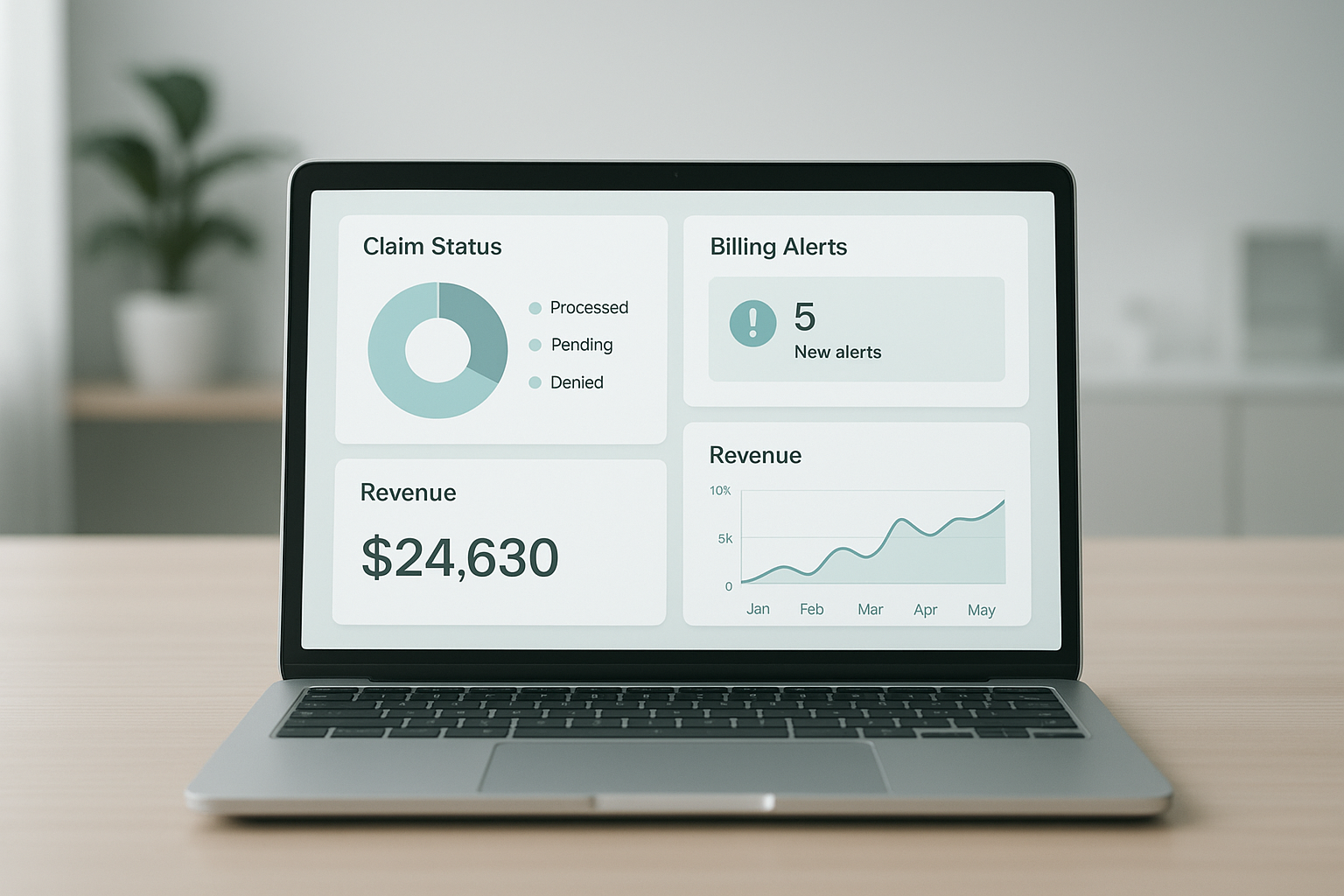
Behavioral health RCM services bring claims, denials, and payments into one visible workflow.
Why Behavioral Health Revenue Cycle Management Needs Specialization
Insurance-based group practices often outgrow spreadsheets and generic billing tools faster than owners expect. Specifically, once a practice crosses five or six clinicians, manual tracking of claim status, denials, and client balances becomes nearly impossible to manage by memory alone.
Furthermore, payers apply different rules to behavioral health claims than to medical claims, including stricter documentation requirements and session caps. Consequently, practices that treat mental health billing like any other specialty tend to see higher first-pass denial rates and slower reimbursement.
Industry benchmarking from groups such as the Medical Group Management Association has long suggested that specialty practices with inconsistent eligibility checks and documentation gaps see denial rates well above the broader healthcare average. In behavioral health specifically, that gap is frequently tied to unsigned notes, supervision sign-off delays, and missed authorization renewals.
Core Components of Behavioral Health RCM Services
A complete behavioral health RCM service touches every stage of the claims lifecycle rather than just one piece of it. Below are the components that matter most for insurance-based practices.
Claims Creation and Submission
This includes guided claim building, correct CPT and modifier selection, and electronic routing to the right payer the first time. Clean claims submitted correctly the first time avoid the rework cycle that drains billing staff hours.
Denial and Rejection Management
When a claim bounces back, a strong RCM workflow routes it immediately for correction rather than letting it sit in a queue. For a deeper look at fixing recurring denial patterns, see this guide to denial management for behavioral health claims.
Aging Accounts Receivable Follow-Up
Claims older than 30, 60, or 90 days need active follow-up, not passive tracking. Without this discipline, revenue quietly ages past timely filing limits and becomes unrecoverable.
Supervisory Billing
Practices that employ prelicensed clinicians need claims tied correctly to supervisor co-signatures and billing provider rules. This is one of the most frequently mishandled areas in behavioral health RCM, since many generic platforms were never built with supervision structures in mind.
How Behavioral Health RCM Services Work: A 5-Step Process
Understanding the workflow helps practice owners evaluate whether their current system, or a prospective vendor, actually covers the full cycle.
- Verify eligibility before the session. Confirm coverage, copay, deductible status, and authorization requirements before the appointment happens, not after.
- Complete and sign clinical documentation. The claim should not be released until the related note or supervision co-signature is finished.
- Create and scrub the claim. Apply correct codes and modifiers, then run an automated check before submission.
- Submit electronically and track status. Monitor acknowledgment and processing until the payer returns a decision.
- Post payments and resolve denials. Reconcile remittances immediately and route denials into correction workflows without delay.
Each step depends on the one before it. Therefore, a gap anywhere in the chain, such as an unsigned note or a missed eligibility check, slows down everything that follows.
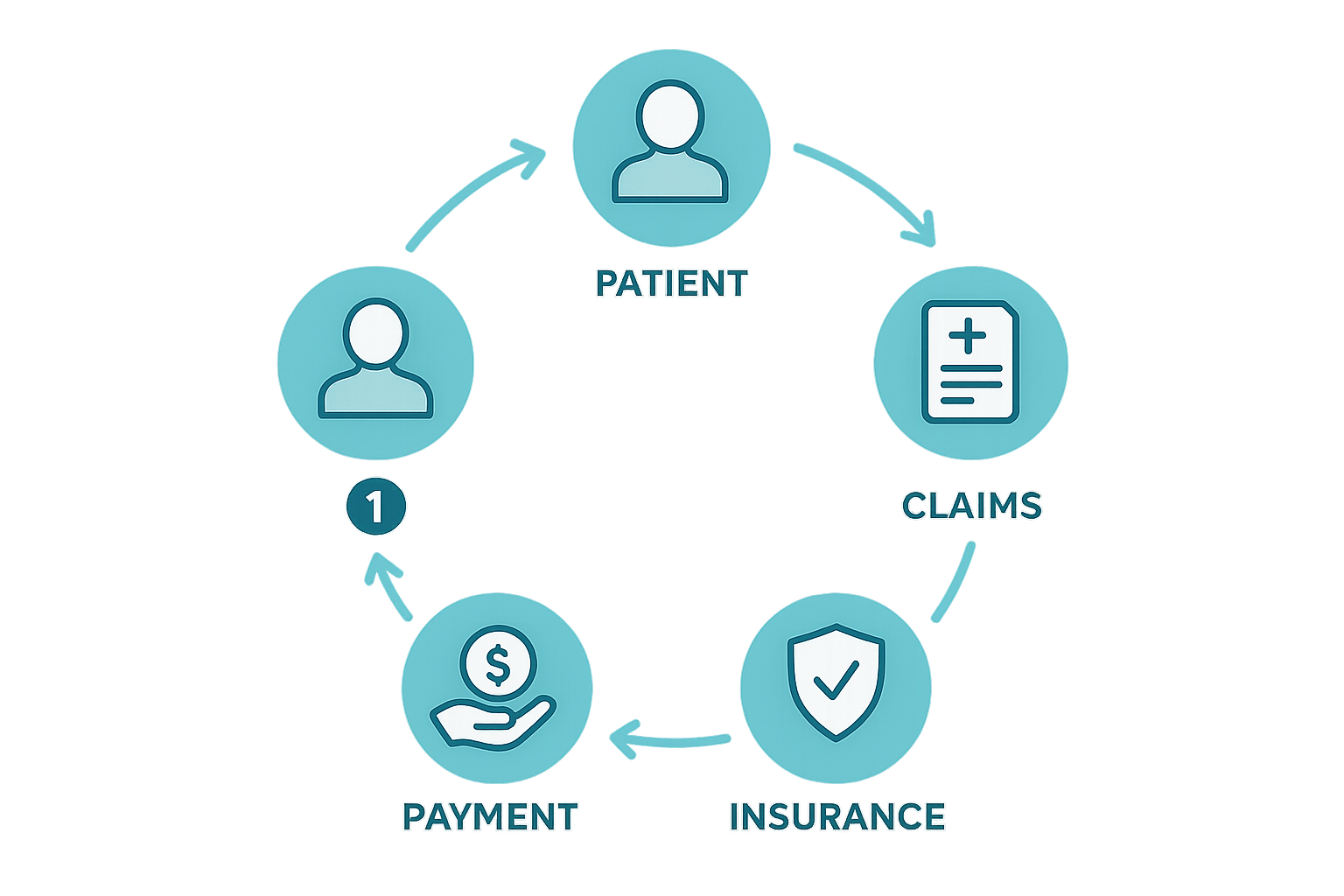
A clear, sequential workflow is what separates reliable behavioral health RCM services from reactive billing.
In-House vs. Outsourced RCM for Behavioral Health Practices
Some practices keep billing in-house because it offers direct control and faster internal communication. However, in-house billing only scales well when the practice has dedicated, trained staff and the volume to justify that overhead.
On the other hand, outsourced RCM for behavioral health shifts claim submission, denial follow-up, and payment posting to an external team or platform-based service. This often makes sense for practices scaling past a handful of clinicians, since it frees owners from day-to-day billing minutiae.
In practice, many group practices land on a hybrid approach: they use software that automates the heavy lifting, such as eligibility checks and claim scrubbing, while deciding case by case whether to manage submission internally or add a billing service layer on top.
Common Mistakes That Sabotage Behavioral Health Revenue Cycles
Even well-run practices fall into predictable traps. For instance, letting documentation and billing live in separate systems almost guarantees that unsigned notes will hold up claims without anyone noticing until payment is already delayed.
Similarly, treating insurance eligibility checks as a one-time task rather than an ongoing process leads to claims submitted against lapsed or inactive policies. In addition, practices that lack a clear supervision billing workflow often misroute claims for prelicensed clinicians, which triggers avoidable denials.
Above all, the biggest mistake is reactive billing: discovering a problem only after a claim has already been denied or aged past filing limits. Proactive alerts, rather than after-the-fact reports, are what actually prevent revenue loss.
How TuskaMind Supports Behavioral Health RCM Services
TuskaMind was built by a licensed clinician and group practice owner who managed roughly 70 to 100 daily insurance claims across close to 50 clinicians and contractors. That background shaped a platform where revenue cycle management is tied directly to documentation, supervision, and scheduling, rather than bolted on as a separate system.
Specifically, TuskaMind combines claim creation, rejection and denial management, ERA reconciliation, aging accounts receivable follow-up, and payment posting with practice-wide alerts that flag problems before they become denied claims. Practices can run billing themselves within the platform or add TuskaMind's full-service RCM option for additional support.
Because supervisory billing is a core feature rather than an afterthought, practices employing prelicensed clinicians can track hours, route co-signatures, and bill correctly under the right provider without juggling a separate spreadsheet. To see how this fits into a broader insurance-based software evaluation, review this guide to insurance-based behavioral health software.
Choosing the Right Behavioral Health RCM Partner
When evaluating behavioral health RCM services, owners should ask whether the vendor actually understands mental health billing rules or whether it was adapted from general medical software. A platform that was never designed around therapy session codes, supervision, and payer-specific documentation will almost always require workarounds.
It also helps to confirm that billing connects directly to clinical documentation. For example, a treatment plan system and progress notes should feed straight into the claim rather than requiring manual re-entry, and a modern behavioral health EHR should make documentation readiness visible before a claim is even generated.
Finally, security matters just as much as billing accuracy. Any RCM vendor handling protected health information should operate under HIPAA-aligned safeguards; the U.S. Department of Health and Human Services HIPAA resource outlines the baseline requirements every practice should verify with a vendor. Practices exploring their options can start by reviewing TuskaMind's platform overview directly.
Frequently Asked Questions About Behavioral Health RCM Services
What are behavioral health RCM services?
Behavioral health RCM services are specialized revenue cycle management processes that handle claim creation, submission, denial follow-up, payment posting, and insurance oversight for therapy, counseling, and psychiatric practices. They differ from general medical billing because they account for session-based coding, supervision billing, and payer rules specific to behavioral health.
How do behavioral health RCM services differ from general medical billing?
Behavioral health billing involves unique CPT codes, session limits, authorization rules, and documentation standards that general medical billers often misapply. Specialized RCM teams understand these nuances, which reduces denials tied to incorrect coding or missing clinical notes.
How much do behavioral health RCM services cost?
Pricing typically runs as a percentage of collections, often between roughly 4% and 9% depending on claim volume and service scope. Some platforms let practices choose between self-managed billing tools or an added full-service RCM layer.
How long does it take to see results after outsourcing RCM?
Most practices notice improved claim turnaround within 60 to 90 days as backlogged claims get reworked and new submissions follow cleaner workflows. Full stabilization of aging accounts receivable usually takes two to three billing cycles.
What causes most behavioral health claim denials?
Common causes include expired insurance eligibility, missing or unsigned clinical documentation, incorrect modifier use for supervised sessions, and authorization lapses. Many of these issues are preventable with real-time alerts before a claim is submitted.
Should a solo therapist outsource RCM?
Solo clinicians with low claim volume can often manage billing manually, but outsourcing or using an automated RCM tool saves time once insurance panels grow. As a practice adds clients, the administrative burden usually outweighs the cost of support.
Can behavioral health RCM services handle supervisory billing for prelicensed clinicians?
Yes, though this requires a platform built specifically for behavioral health supervision structures. Supervisory billing connects a supervisee's documented session to a supervisor's co-signature before the claim is submitted correctly under the appropriate billing provider.
What is the difference between in-house and outsourced behavioral health RCM?
In-house RCM keeps billing staff on payroll and gives the practice direct control, while outsourced RCM shifts claim submission and follow-up to an external team or platform-based service. The right choice depends on claim volume, staffing capacity, and how much oversight the owner wants to retain.
How do behavioral health RCM services improve cash flow?
By catching eligibility issues and documentation gaps before submission, RCM services reduce first-pass denials and shorten the time between service delivery and payment. Consistent aging accounts receivable follow-up also prevents revenue from quietly going uncollected.
What should a practice look for when choosing an RCM partner?
Look for behavioral-health-specific experience, transparent reporting, supervisory billing support, and integration with existing documentation and scheduling tools. Avoid vendors that treat mental health claims the same as general medical claims.
Do behavioral health RCM services integrate with EHR and documentation?
Strong RCM services tie billing directly to clinical documentation, so a claim cannot go out until the related note is complete and signed. This integration prevents the common problem of billing delays caused by incomplete charting.
What role does AI play in modern behavioral health RCM services?
AI tools can suggest CPT codes, flag missing documentation fields, and draft notes faster, which indirectly speeds up the billing cycle. Some platforms also use automated alerts to catch denial risks before claims leave the system.
How do behavioral health RCM services handle insurance eligibility verification?
Eligibility checks are typically run before the first session and periodically afterward to catch coverage changes, lapsed policies, or new authorization requirements. Automated alerts notify billing staff when a client's insurance status changes mid-treatment.
What happens if claims are not reviewed regularly?
Unreviewed claims age past timely filing limits, and denials go uncorrected until they are no longer recoverable. Regular review cycles, ideally weekly, prevent revenue from being lost to deadlines rather than actual payer rejection.
Key Takeaways
Ultimately, behavioral health RCM services exist to catch problems before they cost a practice money, not simply to process claims after the fact. From eligibility verification through denial correction and aging accounts receivable follow-up, each stage of the revenue cycle depends on documentation, supervision, and billing working from the same source of truth.
As practices grow past a handful of clinicians, manual tracking stops scaling, and the cost of fragmented systems shows up directly in delayed payments and denied claims. Therefore, whether a practice manages billing in-house, outsources it, or uses a platform like TuskaMind that combines both options, the goal remains the same: visibility into what needs attention right now, before it becomes a revenue problem.
Practices ready to evaluate their options can review the broader TuskaMind platform to see how behavioral health RCM services, documentation, and supervision can work together in one system rather than several disconnected tools.