
Denial management behavioral health claims work is the process of catching, correcting, and preventing insurance claim rejections so mental health practices actually get paid for the care they deliver. For solo clinicians and growing group practices alike, denials are not just an annoyance; they are a direct drain on cash flow, staff time, and clinician morale. Understanding how to manage denials well, rather than simply reacting to them, is one of the highest-leverage skills a behavioral health practice owner can develop.
Direct answer: Denial management behavioral health claims means identifying why a claim was rejected, correcting the documentation, eligibility, or coding issue behind it, resubmitting within the payer's deadline, and tracking the pattern so the same error does not repeat. Done well, it shifts a practice from reacting to denied revenue to preventing it in the first place.
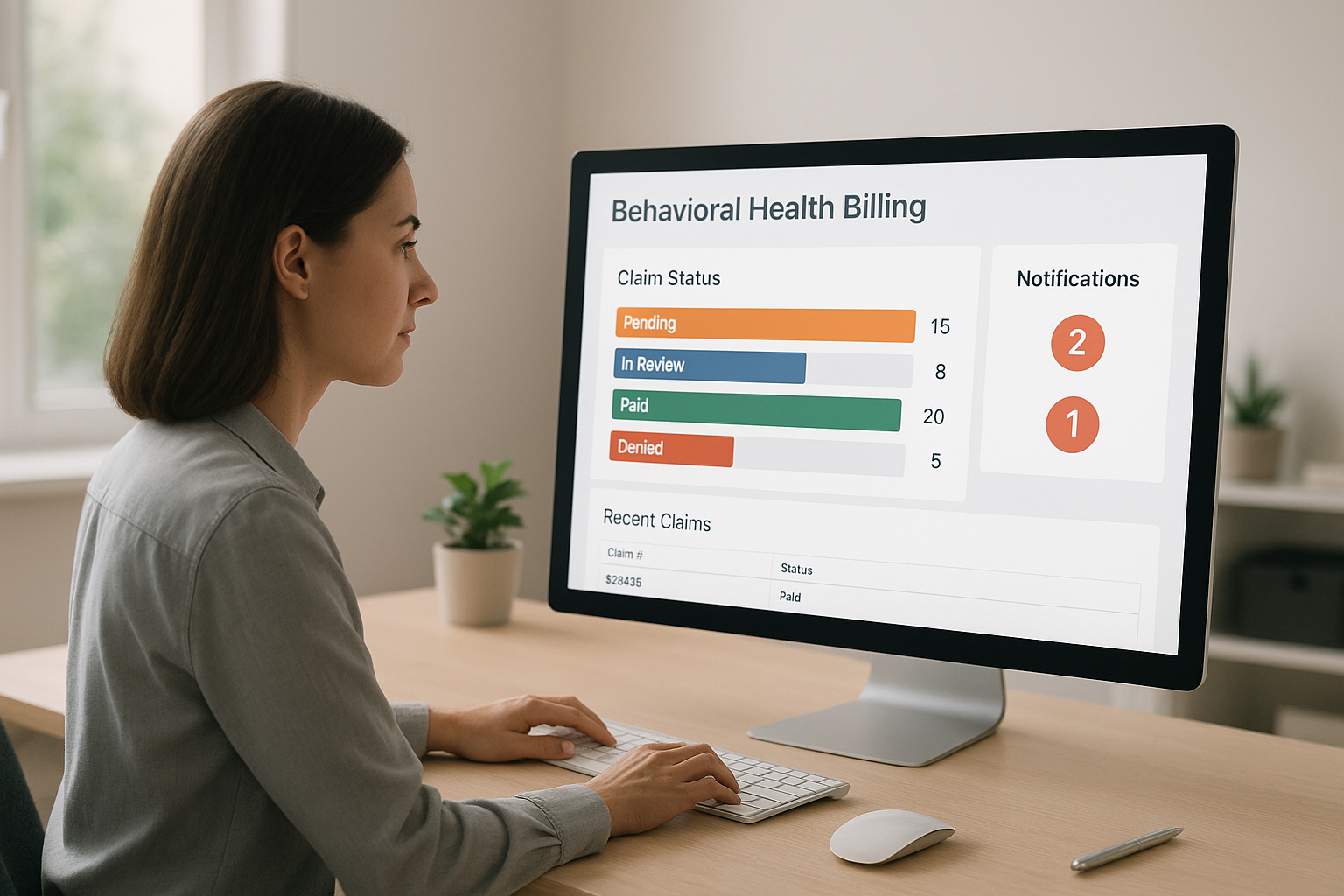
A clear view of denial management behavioral health claims activity helps billing teams act before small errors become lost revenue.
What Is Denial Management for Behavioral Health Claims?
Denial management is the set of workflows a practice uses to respond to rejected or denied insurance claims and stop the underlying cause from recurring. In behavioral health specifically, it also has to account for things general medical billing rarely touches, such as session limits, ongoing authorization renewals, and supervision requirements for associate-level clinicians.
In practice, this means a billing team does not just resubmit a corrected claim. Instead, they trace the denial back to its origin, whether that is a lapsed eligibility check, a missing co-signature, or an outdated CPT code, and adjust the workflow upstream so the error cannot happen again.
Why Behavioral Health Claim Denials Are a Distinct Problem
Behavioral health practices face a denial landscape that differs meaningfully from general medical billing. For example, many payers cap the number of covered therapy sessions per year, require prior authorization renewals mid-treatment, and apply unique rules to group, family, and telehealth sessions.
In addition, practices that train prelicensed clinicians under supervision face a layer of billing complexity that most EHRs were never built to handle. According to guidance published by the American Psychological Association, supervision documentation requirements vary significantly by state, which means a supervisory billing error in one jurisdiction may not even be a risk in another. Consequently, practices operating across multiple states face a compounding denial risk unless supervision and billing data live in the same system.
As a result, generic EHR filing cabinets that simply store claim history after the fact leave owners discovering problems only once revenue has already stalled.
Common Causes of Behavioral Health Claim Rejections
Most behavioral health denials trace back to a short list of recurring issues. Recognizing them is the first step toward preventing them.
- Eligibility gaps: coverage lapsed or changed between sessions without being rechecked.
- Missing authorization: treatment continued past an approved session count.
- Documentation delays: notes left unsigned, holding up claim submission.
- Coding errors: incorrect CPT codes or modifiers for telehealth or group sessions.
- Supervision gaps: missing co-signature or supervision hour records for associate clinicians.
Furthermore, the Centers for Medicare & Medicaid Services notes that claim accuracy at first submission is one of the strongest predictors of overall reimbursement speed, which underscores why prevention matters more than correction after the fact.

Unsigned documentation is one of the most frequent triggers behind avoidable behavioral health claim denials.
A Step-by-Step Denial Management Process
Building a repeatable process turns denial management from a scramble into a system. The following sequence reflects how high-volume behavioral health billing teams typically structure their workflow.
- Identify and categorize every denial by logging the specific reason code, payer, and clinician so patterns become visible rather than buried in paperwork.
- Verify eligibility proactively before each session rather than after a claim bounces back, since coverage changes are a top denial cause.
- Correct and resubmit promptly, fixing the specific issue and attaching supporting documentation well before the payer's filing deadline.
- Track patterns by payer and code on a weekly basis to catch a particular insurer or CPT code generating repeat problems.
- Escalate and appeal when justified, filing a formal appeal with clinical backup rather than writing off revenue that was denied in error.
How TuskaMind Supports Denial Management Behavioral Health Claims
TuskaMind was built by a licensed clinical supervisor who ran a Colorado group practice processing roughly 70 to 100 insurance claims a day. That operational history shaped a platform where denial management behavioral health claims activity is not buried in a separate billing tool, but visible on the same dashboard as documentation, supervision, and eligibility status.
Specifically, the platform's revenue cycle management workflow covers claim creation, electronic submission, rejection and denial handling, aging accounts receivable, and ERA reconciliation in one connected flow. Meanwhile, practice-wide alerts flag unsigned notes, expiring authorizations, and supervisory sign-off gaps before they ever reach a payer, which is often the difference between a clean claim and a denied one.
You can review the full breakdown of these capabilities on the TuskaMind features page, and practices evaluating data protection standards can check the security overview for HIPAA and HITECH architecture details.
Best Practices to Prevent Insurance Denials Before They Happen
Prevention is consistently cheaper than correction. Therefore, practices that invest in upstream checks see fewer denials overall, not just faster resolution of the ones that occur.
Above all, tie documentation completion directly to billing readiness so a claim physically cannot go out until the note behind it is finished and signed. Similarly, build eligibility verification into the scheduling workflow itself, rather than treating it as a separate task someone has to remember.
In particular, practices with prelicensed clinicians should track supervision hours and note co-signatures inside the same system that handles billing, since supervisory billing errors are a distinct and often overlooked denial category. For a closer look at how TuskaMind approaches early access to these workflows, see the Pilot Partner Program details.
What Denials Really Cost a Growing Practice
The financial weight of poor denial management is easy to underestimate. Industry benchmarking commonly cited across healthcare revenue cycle research puts average claim denial rates between 6 and 13 percent, with each reworked claim costing roughly $25 or more in staff time alone, according to figures referenced by the U.S. Department of Health and Human Services on administrative billing burden. For a practice submitting 80 claims a day, even a modest denial rate translates into dozens of hours of rework every month. Consequently, the return on building a solid denial management process compounds quickly as a practice scales past a handful of clinicians.

Tracking aging accounts receivable alongside denial trends gives practice owners an early warning before revenue problems grow.
Frequently Asked Questions
What is denial management in behavioral health claims?
Denial management behavioral health claims is the structured process of catching, correcting, and resubmitting rejected mental health insurance claims while fixing the root causes so future claims are not denied. It combines eligibility checks, documentation review, coding accuracy, and appeals tracking into one workflow.
How does denial management differ for behavioral health versus medical claims?
Behavioral health claims involve extra layers like session limits, prior authorizations for ongoing therapy, and supervisory billing for prelicensed clinicians that general medical claims rarely face. As a result, denial reasons and documentation requirements are more specialized.
What are the most common reasons behavioral health claims get denied?
Common reasons include lapsed or unverified eligibility, missing prior authorization, incorrect CPT or modifier codes, unsigned clinical notes, and exceeding payer session limits. Supervision documentation gaps for associate-level clinicians also trigger denials.
How long does the appeals process typically take?
Most payers require a first-level appeal response within 30 to 60 days, though timelines vary by state and plan type. Practices that track deadlines closely recover more revenue than those relying on manual spreadsheets.
How much does claim denial cost a behavioral health practice?
Average claim denial rates across healthcare run between 6 and 13 percent, and each reworked claim can cost a practice $25 or more in administrative time. For a practice submitting 80 claims a day, unmanaged denials quickly become thousands of dollars in lost or delayed revenue.
What mistakes cause repeat denials?
Repeat denials usually happen when practices fix the immediate claim but never address the underlying cause, such as a recurring eligibility gap or a documentation habit. Without tracking denial patterns by payer, the same error resurfaces on future claims.
How can practices prevent denials before submission?
Practices prevent denials by verifying eligibility before every session, requiring signed notes before billing, and using automated alerts for missing authorizations. Building these checks into daily workflow stops errors before claims ever leave the building.
What role does documentation play in denial prevention?
Clinical documentation is the foundation payers use to justify medical necessity, so unsigned or incomplete notes are a leading denial trigger. Linking documentation status directly to billing readiness prevents claims from going out before notes are finalized.
Can prelicensed clinician supervision affect claim denials?
Yes, supervisory billing errors are a distinct denial risk because many payers require specific co-signature and supervision documentation for associate-level clinicians. Practices that track supervision hours and sign-offs in the same system as billing reduce this exposure significantly.
What technology helps with denial management?
A unified behavioral health operating system that connects documentation, eligibility, supervision, and claims in real time helps practices catch problems before submission rather than after denial. Platforms like TuskaMind are built specifically around this proactive alert model rather than passive record storage.
How often should practices review denial trends?
Weekly denial trend reviews are a practical minimum for growing practices, with monthly deep-dive reporting by payer and CPT code. Frequent review surfaces patterns early, before they compound into significant aging accounts receivable.
What is the difference between a rejected claim and a denied claim?
A rejected claim never enters payer adjudication because of a formatting or data error, while a denied claim was processed and formally refused for a coverage or documentation reason. Both require correction, but denials often need a formal appeal.
How does eligibility verification reduce denials?
Verifying eligibility before each session confirms active coverage, remaining session limits, and authorization status so claims are built on accurate information from the start. This single step prevents one of the most frequent behavioral health denial categories.
Bringing It Together
Ultimately, denial management behavioral health claims work is not a one-time fix; it is an ongoing discipline that blends eligibility checks, documentation accuracy, coding precision, and supervision oversight into a single proactive system. Practices that treat denial management as a daily habit, rather than a monthly cleanup task, protect their revenue and reduce the administrative strain on billing teams. In short, the practices that win are the ones that catch problems before a payer ever sees them, not the ones scrambling to appeal after the fact. For a closer look at how a connected platform approaches this, visit TuskaMind or review the terms of service before onboarding a new system.