
Supervisory billing software
Supervisory Billing Software for Mental Health Group Practices
TuskaMind connects supervision, documentation, provider roles and payer rules into one workflow, so practices can track claims for pre-licensed clinicians and see why when one isn't ready.
The problem
A paid claim is not necessarily an audit-ready claim
Supervisory billing involves the treating clinician, the supervisor, the rendering and billing provider, payer rules, licensure status and documentation. When those live in separate systems, someone has to keep it all straight by hand.
With one pre-licensed clinician you can get away with that. With five or ten, the manual fixes multiply, and the mistakes often don't show up until an audit.
A correctly submitted insurance claim does not automatically mean the clinical documentation supporting that claim is sufficient for an audit.
Payers may review whether the clinical record supports medical necessity, the services provided, and applicable supervision requirements.
A paid claim can still be subject to review or recoupment.
Clinical supervision and billing are connected. Our technology should recognize that.Zina Ortiz, MA, LPC, Founder of TuskaMind
- Separate treating clinician, rendering, supervising and billing provider
- Claims wait until required supervisory documentation is signed
- Payer-specific supervisory billing rules flagged before submission
- Licensure and credential status tied to billing
- Plain-language reasons when a claim is blocked
- Full audit trail of who reviewed, signed and changed what
TuskaMind is designed to connect clinical documentation, supervisor oversight, and insurance billing so practices have greater visibility into the information supporting their claims.
How it works
One chain, from supervision to payment
If one link is weak, the whole process gets harder. TuskaMind keeps the chain connected.
Pre-licensed clinician documents
The session note is written in the record.
Supervisor reviews
Documentation routes to the assigned supervisor.
Approval and co-signature
Required signatures are captured and logged.
Rules and providers checked
Payer rules, provider roles and codes are checked.
Claim submitted
Claims marked ready are submitted to the payer.
Payment and reconciliation
ERAs, denials and follow-up are worked in one place.
Hours and compliance tracked
Teams can track supervision hours and licensure.

What to look for in supervisory billing software
Why Choose TuskaMind for Supervisory Billing?
Supervisory billing is more than adding a licensed supervisor's name to an insurance claim.
Mental health group practices must coordinate clinical documentation, supervisor approvals, provider credentials, payer-specific billing requirements, and claim submission.
When these responsibilities are disconnected, practices face unnecessary administrative work and potential billing errors.
TuskaMind brings clinical supervision, documentation, and insurance billing into one connected behavioral health EHR.
Supervisor Review Queues
TuskaMind gives clinical supervisors a centralized dashboard to review documentation submitted by their supervisees.
Supervisors can identify pending records, review clinical documentation, return records for correction, and complete required approvals.
This reduces the need to track unsigned documentation through emails, spreadsheets, or individual client charts.
Supervisor links drive routing, so when supervisors change, the workflow follows.
The benefit: Supervisors can see what needs their attention without searching through multiple records.
Clinical Documentation and Nellie AI
TuskaMind includes Nellie AI, an integrated clinical documentation assistant.
Nellie can identify potential missing information, medical necessity concerns, treatment-plan inconsistencies, incomplete interventions, and missing client responses.
The clinician remains responsible for reviewing and correcting documentation. Nellie's findings support, rather than replace, clinical judgment.
Nellie can also help review codes, POS, modifiers and provider fields against the note before submission.
The benefit: Documentation concerns can be addressed before records are approved or submitted for billing.
Supervisory Billing and Provider Roles
Supervisory billing requires practices to distinguish between the treating clinician, supervising clinician, rendering provider, and billing organization.
These responsibilities are not interchangeable.
TuskaMind supports separate provider roles and configurable claim information to accommodate applicable payer requirements.
Treating clinician, clinician of record, rendering, supervising and billing provider aren't one vague “provider” field.
The benefit: More consistent provider identification and reduced dependence on manual billing workarounds.
Payer-Specific Claim Requirements
Commercial insurers and Medicaid programs may have different supervisory billing rules.
TuskaMind supports configurable billing requirements, including relevant provider information and applicable modifiers.
TuskaMind flags when a payer doesn't allow supervisory billing or needs different provider fields.
Practices remain responsible for confirming their individual payer agreements and supervisory billing eligibility.
The benefit: Billing workflows can be organized around the requirements of individual insurance plans.
Supervision Tracking
Clinical supervision is an ongoing responsibility, not simply a signature at the end of a progress note.
TuskaMind supports supervisor assignments and supervision-hour tracking alongside routine clinical operations.
The benefit: Supervisors and practice owners can manage supervision requirements without relying entirely on separate tracking systems.
Role-Based Access
Clinicians, supervisors, billing staff, and practice administrators need different levels of system access.
TuskaMind uses role-based permissions to support appropriate access to clinical, supervisory, and billing functions.
The benefit: Staff can perform their responsibilities without requiring unrestricted access to every clinical record.
Claims Held Until Documentation Is Ready
Claims can wait until the co-signature and required supervisory documentation are in place, instead of going out early because someone clicked submit.
Plain-language reasons show why a claim is on hold.
Audit Trail
TuskaMind provides visibility into who reviewed, signed, corrected or reassigned documentation, and when.
TuskaMind connects clinical documentation, supervisor oversight, and insurance billing so group practices can manage these responsibilities within one platform.
See How TuskaMind Connects Clinical Care and Insurance Billing
A mental health group practice needs more than a place to write progress notes and submit insurance claims.
Clinical documentation must be completed, reviewed when required, and connected to the appropriate billing workflow.
The following TuskaMind interface examples demonstrate how clinicians, supervisors, and billing personnel manage these responsibilities.
Illustrative screenshots with fictional names and sample data.
Step 1 — Complete the Clinical Progress Note and Review It With Nellie AI
TuskaMind allows clinicians to document their sessions within the client's electronic clinical record.
Progress notes include session information, diagnoses, clinical documentation, and applicable service details.
The system includes an Audit and Claim Readiness section that identifies completed information, missing elements, and items requiring review.
Nellie AI helps clinicians and supervisors identify potential documentation concerns before final approval.
Her clinical integrity review can flag missing medical necessity language, incomplete clinical information, or inconsistencies between progress notes and treatment goals.
Findings are advisory and must be evaluated by the responsible clinician.
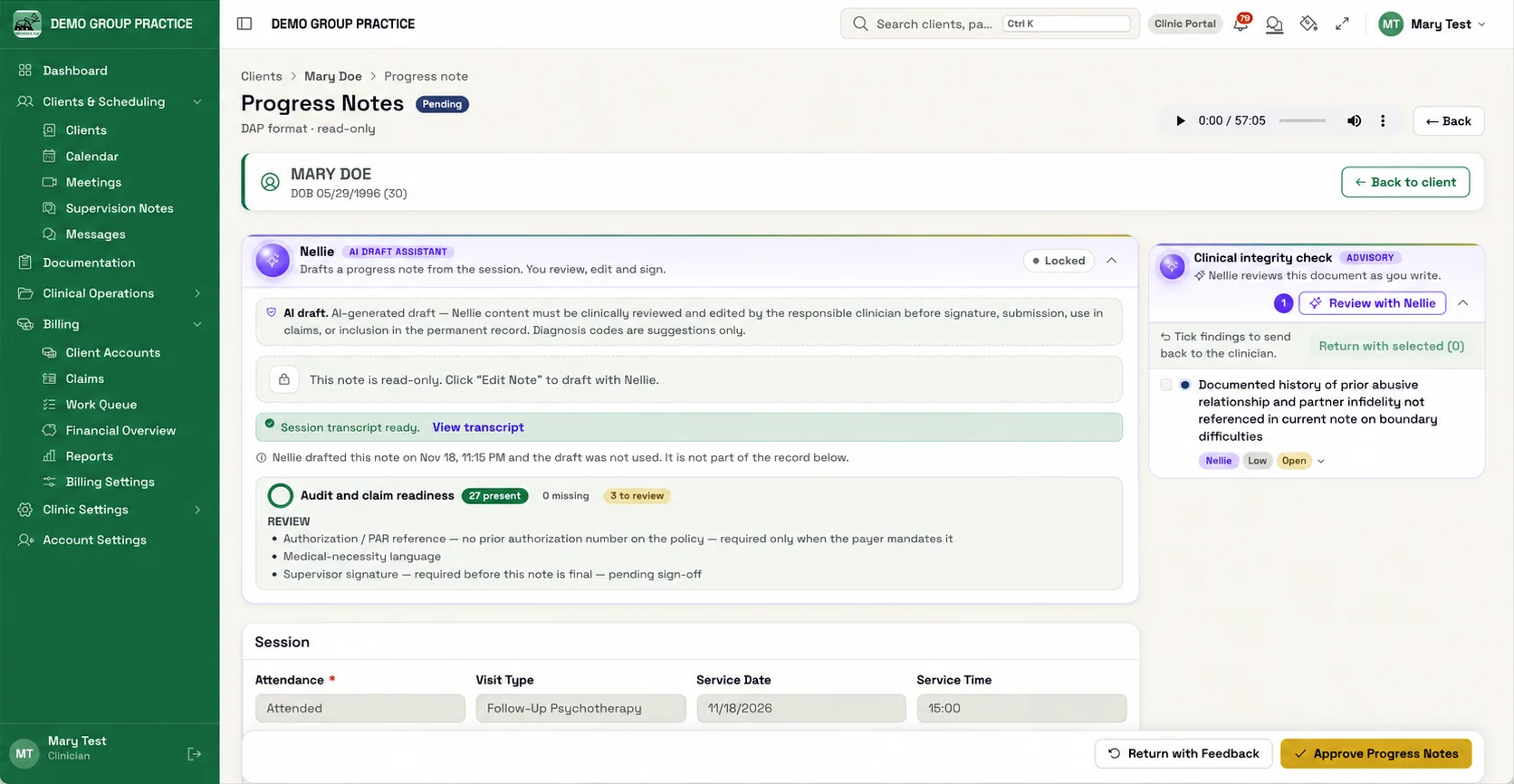
TuskaMind progress notes display documentation completeness, and Nellie AI provides advisory findings for clinical review. Step 2 — Review and Approve Clinical Documentation
TuskaMind provides supervisors with a centralized Approvals dashboard.
The dashboard identifies records awaiting review and displays the clinician, document information, Nellie findings, and approval status.
Supervisors can open the relevant record, review its contents, return documentation with feedback, or complete the available approval action.
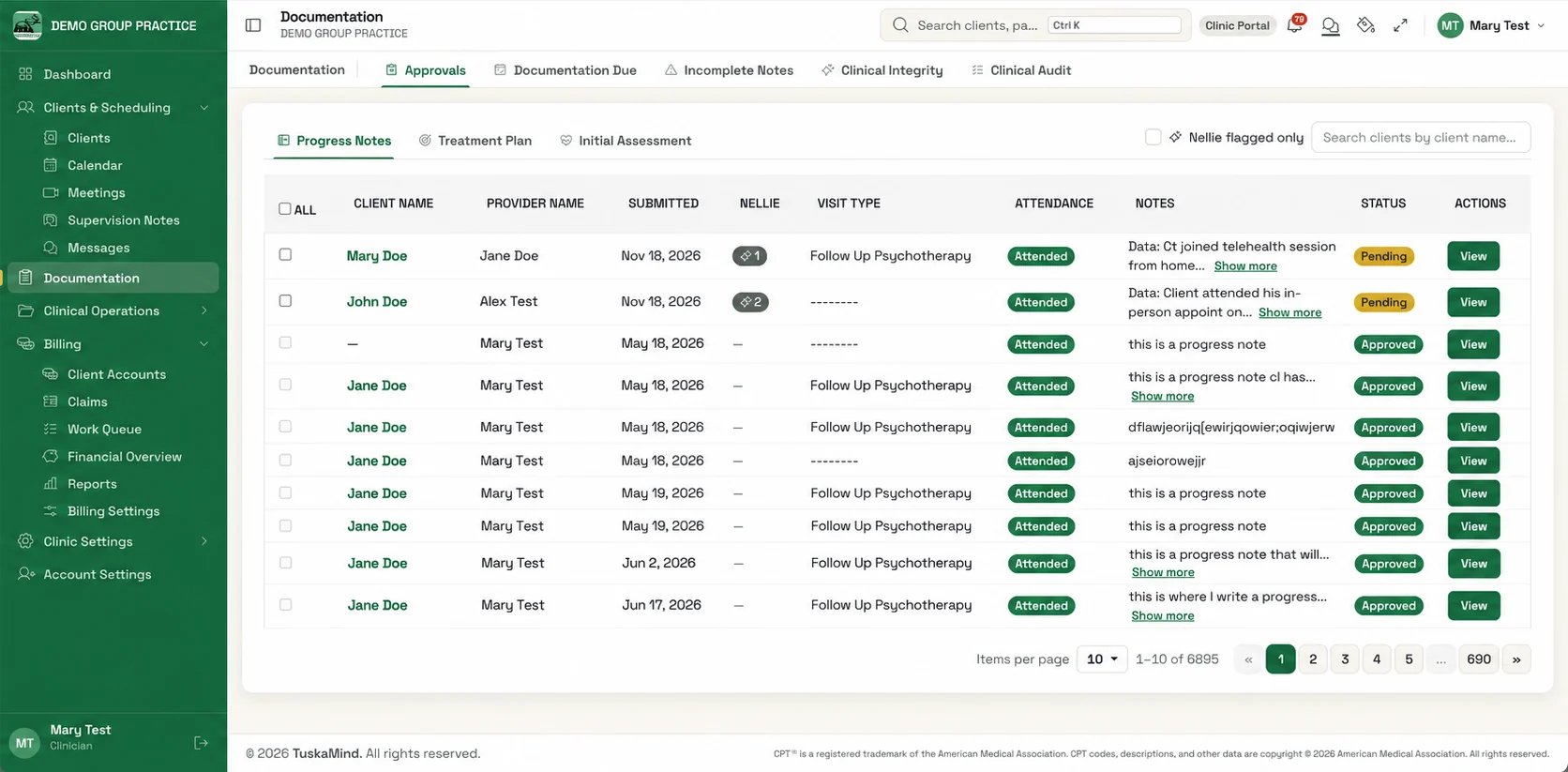
The supervisor approval dashboard displays pending documentation and clinical integrity findings in one review queue. Step 3 — Manage Claims Before Submission
TuskaMind's Claims dashboard allows billing personnel to review claims and their current processing status.
The Draft queue displays claim information, including the clinician, payer, procedure code, billed amount, date of service, and status.
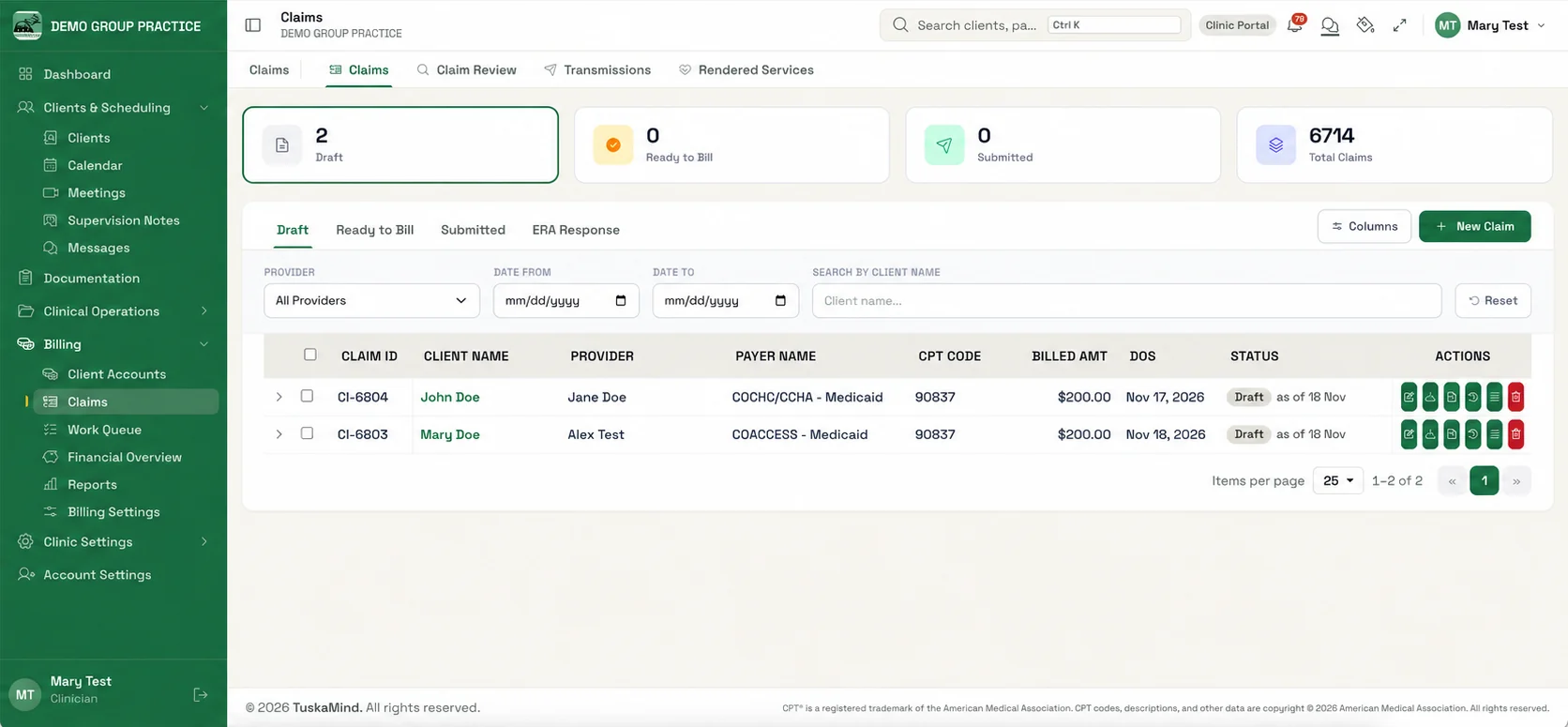
The billing team can review draft claims and their associated service information before submission. Step 4 — Prepare Claims for Submission
The Ready to Bill area provides a separate view of claims that have advanced through the billing workflow.
Authorized billing staff can review claims and use the available submission controls.
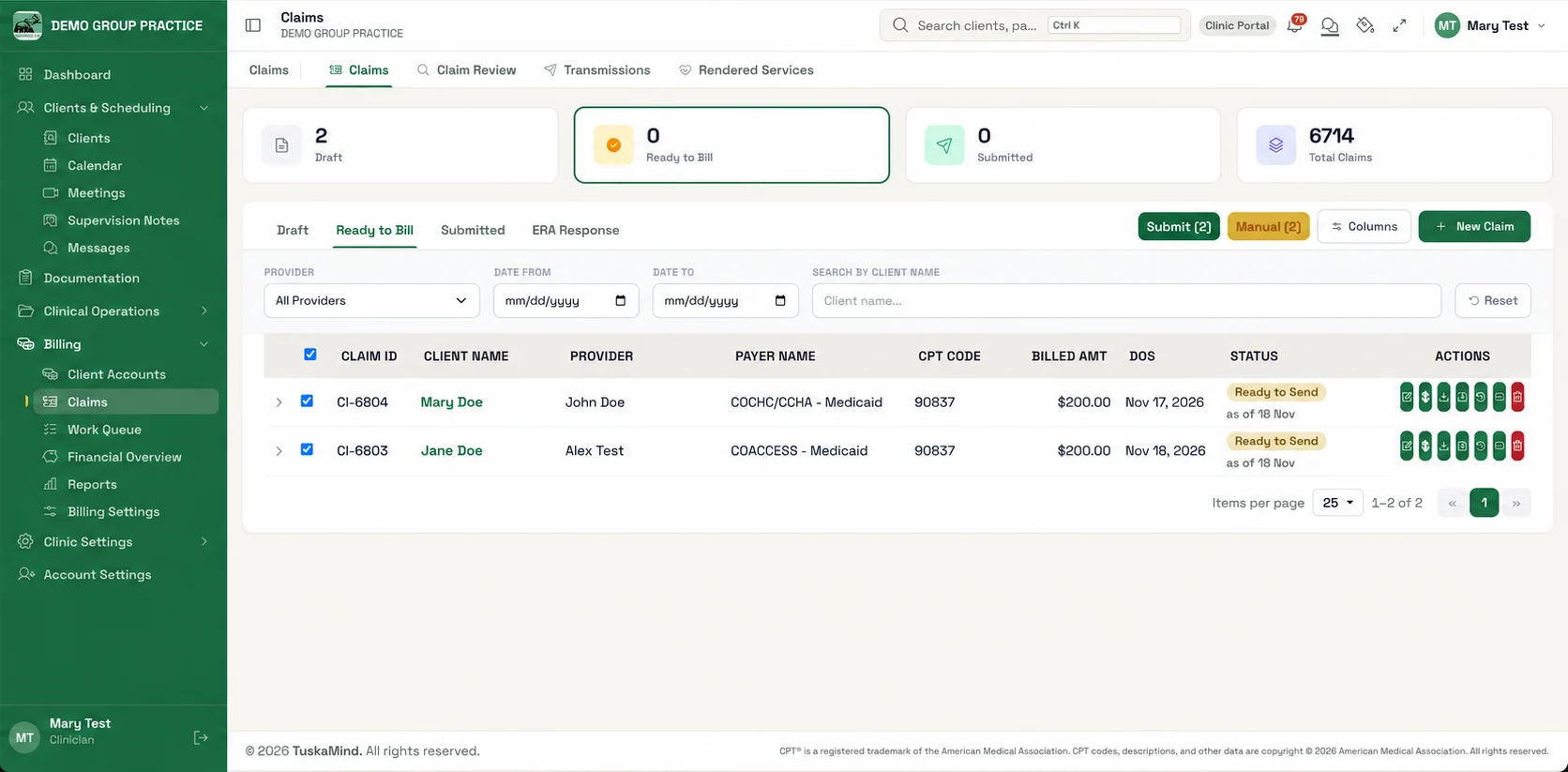
TuskaMind organizes claims by processing status so billing personnel can identify those ready for submission. Step 5 — Track Insurance Claim Responses and Remittances
TuskaMind provides claim tracking through its billing and remittance workflows.
The ERA Response section displays payer response information, including check numbers, procedure codes, service dates, amounts paid, and remaining balances.
TuskaMind's Financial Overview includes a Remittances section for electronic payer responses.
Billing staff can review patient control numbers, insurance payers, dates of service, procedure codes, charges, insurance payment amounts, bank dates, and remittance identifiers.
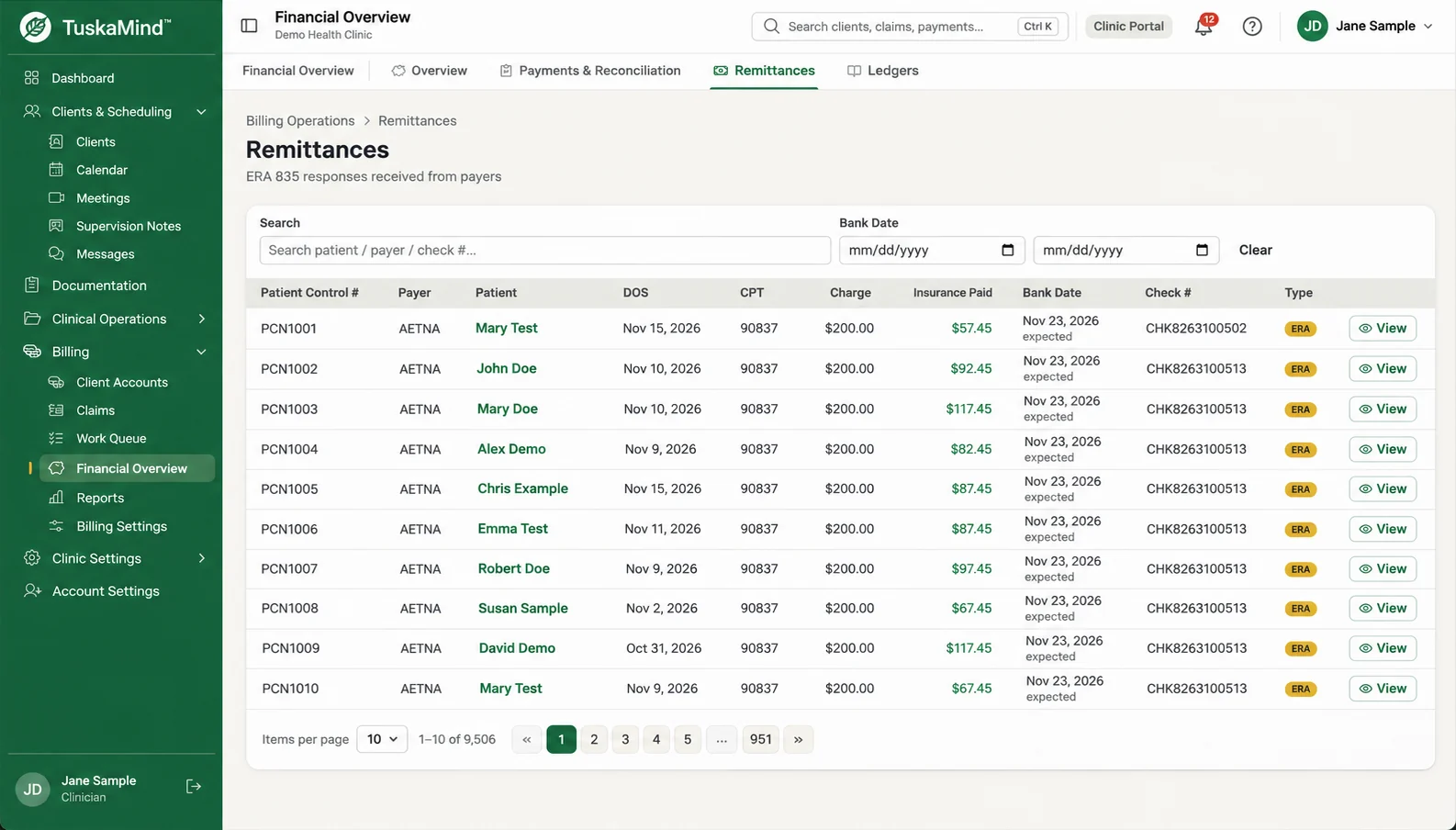
TuskaMind brings electronic remittance information into the financial workflow for payment review and reconciliation.
One Connected Clinical and Billing Workflow
TuskaMind brings clinical documentation, supervisor review, claim management, and insurance remittance information into a connected practice management platform.
For group practices with pre-licensed clinicians, this means clinical and administrative responsibilities can be managed together rather than through disconnected systems.
What Makes TuskaMind Different From a Basic Supervisory Billing Workflow?
Some supervisory billing processes rely on separate steps for clinical documentation, supervisor signatures, insurance claim preparation, and payment tracking.
TuskaMind is designed to connect these responsibilities within the same behavioral health platform.
The following comparison illustrates the difference between an integrated TuskaMind workflow and a workflow managed through disconnected tools.
| Practice responsibility | TuskaMind | Disconnected workflow |
|---|---|---|
| Progress notes | Clinical documentation within the EHR | Documentation may require a separate system |
| Supervisor review | Centralized supervisor approval dashboard | Approvals may require manual follow-up |
| Clinical integrity | Nellie AI identifies potential documentation concerns | Documentation may require separate manual review |
| Supervisor assignments | Supervision responsibilities managed within the platform | Assignments may be tracked separately |
| Provider billing information | Separate provider roles and configurable claim settings | Provider information may require manual entry |
| Claim preparation | Centralized Draft and Ready to Bill queues | Claims may be prepared in a separate billing system |
| Claim status | Claims organized by processing stage | Status may require separate tracking |
| Payer responses | ERA response information in the billing workflow | Responses may require external reconciliation |
| Remittance information | Financial Overview and Remittances workspace | Payment information may be maintained separately |
Designed for Group Practices With Pre-Licensed Clinicians
TuskaMind's specialization is its supervision-centered design.
Rather than treating supervisor approval as an isolated administrative task, the platform connects clinical documentation, supervision responsibilities, and billing workflows.
This makes TuskaMind particularly relevant to mental health group practices managing pre-licensed clinicians, supervisors, and insurance-based services.

Why TuskaMind
Built From Real Group-Practice Experience
TuskaMind was founded by Zina Ortiz, MA, LPC, EMDR-trained psychotherapist and owner of Elephant in the Room LLC, a behavioral health group practice in Colorado.
The platform was developed from firsthand experience managing the clinical and administrative challenges of an insurance-based mental health practice.
Those challenges include supervising pre-licensed clinicians, managing clinical documentation, preparing insurance claims, navigating payer requirements, and maintaining records that can withstand scrutiny.
TuskaMind was built around the belief that an EHR should support the way mental health practices actually operate.
So TuskaMind supports pre-licensed clinicians, supervisors, treating clinicians, rendering and billing providers, documentation review, supervisory billing, claim readiness and supervision tracking in the same behavioral health workflow.
Built for the People Doing the Work
Clinical supervisors need to know which records require review.
Clinicians need clear documentation workflows.
Billing personnel need accurate claim information and visibility into processing statuses.
Practice owners need to understand what is happening across their organizations without reconstructing information from disconnected systems.
TuskaMind brings these responsibilities together.
Built from clinical experience. Designed for the realities of running a mental health group practice.
Nellie AI and audit readiness
Supervisory Billing Doesn't Stop at the Insurance Claim
- Paid claims can still be audited
- Supervisory billing requires documentation support
- Nellie findings are advisory
- TuskaMind connects documentation, supervision, and billing records
Clinical Integrity With Nellie AI
Nellie AI helps clinicians review clinical documentation for potential gaps involving medical necessity, interventions, client responses, risk information, and treatment-plan alignment.
Nellie's findings are advisory. Clinicians remain responsible for clinical decisions, documentation accuracy, and final approval.
Clinical Supervision Within the EHR
TuskaMind supports supervisor assignments, documentation review queues, approvals, co-signatures, and supervision tracking within the clinical workflow.
Audit Readiness Starts Before the Audit
Audit readiness involves more than producing a signed progress note.
Practices must maintain clinical documentation, medical necessity support, appropriate supervision records, and billing information consistent with applicable payer rules.
TuskaMind helps bring these responsibilities into one clinical and administrative workflow.
Supporting Pre-Licensed Therapists
Pre-licensed clinicians require appropriate clinical supervision, documentation oversight, and compliant billing arrangements.
TuskaMind supports these responsibilities within the same EHR used by the practice's clinicians, supervisors, and administrative team.
Connected Documentation. Clearer Oversight. More Organized Billing.
Clinical documentation, supervisor approval, and insurance billing should not function as unrelated processes.
TuskaMind brings them together to help group practices manage supervisory responsibilities and maintain more organized clinical and billing records.
Simple pricing
No per-claim platform fees
Run billing yourself on the platform, or hand off the full revenue cycle.
Licensed clinician or supervisor
Per licensed clinician or clinical supervisor seat.
Pre-licensed clinician / supervisee
Supervisees are priced as supervisees, not as full clinician seats.
Included in every seat
- EHR and clinical documentation
- Telehealth, with EMDR bilateral stimulation tools
- Nellie AI
- Unlimited client records
- Supervision workflows and supervisory billing support
Admin, billing and scheduling staff don't add a clinical seat. Optional full-service RCM is available at 5% of collected insurance reimbursements.
Codes that tell one story
The note, the codes and the claim should agree
A claim is a structured story: what was done (CPT), why (diagnosis), where (POS), how (modifier) and by whom. When the note says telehealth from home but the claim says POS 11, or a pre-licensed clinician's claim has no supervising provider, the payer gets a story that doesn't make sense.
TuskaMind helps flag those mismatches before the claim leaves, so billers and clinicians can review them while they're easier to fix.
FAQ
Common questions
What is supervisory billing in mental health?
Supervisory billing is an arrangement where a qualified, licensed and enrolled clinician takes responsibility for services provided by a pre-licensed clinician working under their supervision. Whether a service can be billed this way depends on the payer, state rules, enrollment and the payer contract.
Is supervisory billing the same as incident-to billing?
No. Incident-to comes from Medicare rules with specific requirements for the supervising professional, the service and the setting. Commercial payers and Medicaid programs may have their own supervisory billing policies, and an arrangement one payer accepts may be rejected by another.
Who goes in the rendering provider field?
It depends on the payer. Some require the enrolled supervisor as rendering provider even when a pre-licensed clinician delivered the service; others want the treating clinician or a supervisor identifier. TuskaMind keeps the treating clinician, rendering, supervising and billing provider as separate roles to help practices keep the claim and the record consistent.
Can TuskaMind hold a claim until supervision is complete?
Yes. Claims can wait until the note is complete, the required supervisor review and signature are in place and the provider information is correct, and the system explains in plain language why a claim is blocked.
Does TuskaMind know each payer's supervisory billing rules?
TuskaMind supports payer-specific rules and flags issues before submission. Software can't decide that a payer permits supervisory billing when its rules say otherwise, so practices should keep written payer guidance and review it regularly.
Does TuskaMind charge per claim?
No. TuskaMind doesn't charge a per-claim platform fee. Practices can run billing themselves, or use optional full-service RCM at 5% of collected insurance reimbursements.
This page is educational and isn't billing or legal advice. Supervisory billing requirements vary by payer, state, service, provider qualifications and contract. Always verify requirements before submitting claims.
Keep exploring
More of what TuskaMind is built for
Stop running supervisory billing from a spreadsheet
See how TuskaMind connects supervision, documentation and claims for your pre-licensed clinicians.