
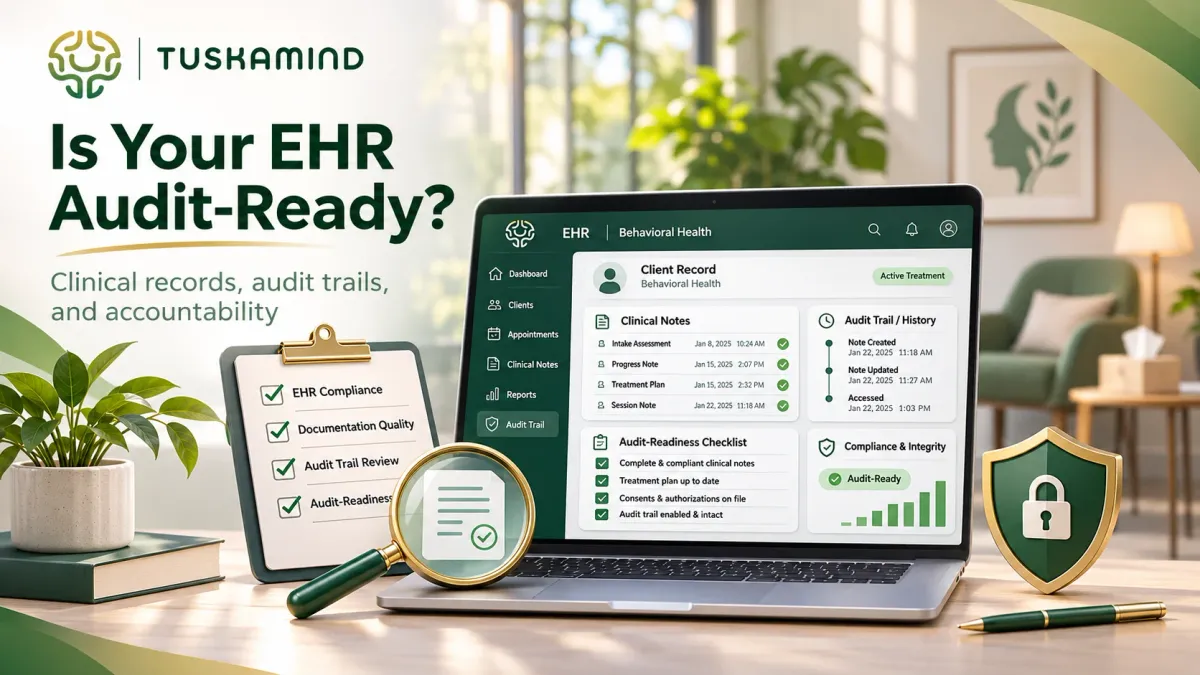
Is Your Mental Health EHR Really Audit-Ready? 7 Questions Every Group Practice Owner Should Ask
By Zina Ortiz, MA, LPC, Psychotherapist, Group Practice Owner, and Founder of TuskaMind
Your EHR tells you your progress notes are complete. They're signed. They're saved. They're sitting comfortably in some HIPAA compliant database. Wonderful!
Now an insurance company requests a random number of clinical notes from two years ago. They've asked for initial assessments, treatment plans, progress notes, documentation supporting medical necessity, and evidence that the services were billed appropriately.
Depending on the audit, they may also ask for signatures, amendments, or supervisory arrangements. Can your EHR produce the information you need? Or is this the moment when you discover that your supposedly sophisticated electronic health record system is just a very expensive filing cabinet? I've spent years managing a mental health group practice, and I've picked up a few valuable lessons.
Having an electronic health record does not automatically mean your clinical records are audit-ready.
And there's a rather substantial difference between storing a progress note and being able to defend the accuracy and data of that note. Let's dive in, shall we?
What Does It Mean for a Mental Health EHR to Be Audit-Ready?
An audit-ready mental health EHR is a system that helps a practice maintain accurate clinical documentation, collect and stamp required reviews and signatures, store appropriate record histories, and retrieve the information needed to respond to legitimate audits.
But let's make one thing clear.
No EHR can guarantee that your practice will pass an insurance audit.
The software cannot establish medical necessity simply because a clinician completed a template. It's not about the storage, it's about the content of these documents, what's written in these documents. It cannot validate the service posted in a claim.
And it certainly cannot substitute for appropriate clinical judgment. Hell no! What a well-designed behavioral health EHR can do is help clinicians and practice administrators maintain better records and identify potential problems before those problems become expensive. Refunding or returning money reimbursed for a number of claims is painfully expensive financially and emotionally. I think that's a reasonable expectation.
1. Can Your EHR Show When a Progress Note Was Created, Edited, and Signed?
Let's begin with something that should be relatively clear and simple. A therapist provides a psychotherapy session on Monday. The progress note is written on Tuesday. The therapist signs it on Thursday. Two weeks later, the note is amended. What information does your EHR show about that sequence of actions? Does it show when the record was created? The date it was signed? Who made the amendment? Did the amendment occur before or after the original signature?
An EHR should make it possible to maintain and retrieve appropriate records of these activities.
Why does this matter? Because the date of service and the date a note was completed are not necessarily the same. An electronic signature on a document doesn't automatically explain everything that happened before or after it was signed.
An audit-ready documentation workflow should preserve accurate timestamps and identifiable authorship rather than silently rewriting the history of a clinical record. It's not like a Word document: select, delete and start a new sentence.
Of course, the specific information required for a particular audit depends on the payer, the circumstances, and applicable regulations. Some can be very easy to complete and others do look at these documents with a microscope. But I would much rather have reliable historical information available than discover I need it after receiving a records request.
2. Can You Retrieve Historical Versions and Clinical Record Amendments?
Here's a question I didn't fully appreciate until dealing with historical records from a previous EHR (TheraNest, in case you don't know). What happens to the original version of a progress note after someone edits it? Some EHR systems preserve versions or amendment histories. Others may maintain technical activity records separately from the clinical document. Some exports provide only the current version of a record. These differences matter, and they're asked for.
Suppose an initial assessment is completed, signed, and subsequently amended to correct a factual error. Can you establish what changed? How does one explain what changed, and when?
Corrections and amendments are legitimate parts of clinical documentation when performed properly. The problem isn't that records sometimes require correction. The problem is when corrections obscure what previously existed or when nobody can establish what happened, and there is no record of these changes.
A reliable EHR should support transparent amendments, not invisible revisions.
No one expects therapists to be perfect. We're human, and human error comes with that. I do expect clinical records to accurately reflect the work performed, errors and corrections included.
That's a meaningful distinction.
3. Can Your EHR Demonstrate Appropriate Clinical Supervision?
Now let's discuss something particularly relevant to mental health group practices employing pre-licensed clinicians. My favorite topic, clinical supervision. And no, I don't mean simply having a supervisor's name somewhere in the employee profile. I'm talking about actual documentation oversight.
Depending on the clinician's credentials, payer, and applicable supervision arrangement, there may be requirements involving review, signatures, oversight documentation, or other evidence of supervisory involvement.
Here is a list of questions to consider when shopping for an audit-ready EHR:
Can your EHR identify which clinician was assigned to which supervisor?
Can it show whether required clinical documents were reviewed?
Can it preserve the dates of review, edits and their signatures?
Can it identify documents that remain incomplete or unsigned?
And can supervisors request corrections without losing the original documentation history?
These are not unreasonable requirements. They are operational realities for many group practices. I know because I have dealt with these types of audits.
Yet some systems leave supervisors sorting through disconnected lists, emails, and spreadsheets just to identify what requires attention. I don't know about you, but when I think about clinical supervision, I envision professional development, thoughtful clinical guidance, and accountability. Not an afternoon spent searching for missing signatures like a detective investigating a cold case.
A behavioral health EHR should make appropriate supervision easier to document, verify, and manage.
It should also distinguish clinical supervision requirements from payer-specific rendering provider oversight and supervisory billing rules. Because those are related responsibilities, but they are not always identical.
4. Do Your Progress Notes Actually Support Medical Necessity?
This might be one of the most important questions of all. A completed progress note isn't necessarily a clinically sufficient progress note. And a signed note isn't necessarily an audit-ready note. I've reviewed clinical documentation over the years and noticed a recurring issue. Sometimes the notes contain plenty of words but they don't actually explain much. A progress note may describe what the client talked about without noting the intervention provided. Empty words do not support medical necessity or reimbursement.
The progress note or initial assessment may mention symptoms without explaining how those symptoms affect functioning or why continued treatment is medically necessary. Sometimes the treatment plan contains goals so generic they could apply to nearly every client in the practice. "Client will improve coping skills." Wonderful! But they don't explain how, which skills are to be taught, what symptoms are to be addressed, how progress is measured, or which assessment tools are used, if any. And are the assessment tool results considered in the initial assessment and treatment plan?
These are the types of questions clinicians should consider when documenting treatment.
What Should an Audit-Ready Psychotherapy Progress Note Include?
The specific requirements depend on the payer and service, but documentation should generally support the clinical work performed.
Relevant elements may include:
The service date, type, and duration.
The symptoms, concerns, and functional impairments addressed.
The clinical interventions provided.
The client's response to treatment.
Progress toward relevant treatment goals.
The rationale for continued treatment when applicable.
Clinically appropriate follow-up plans.
Required clinician signatures and other documentation.
The goal isn't to write a novel.
It's to document enough accurate, clinically relevant information to support the service.
More words don't necessarily mean better documentation.
And a beautifully written note that doesn't describe the actual treatment provided isn't particularly useful during an audit.
5. Can Your EHR Identify Who Accessed or Modified Clinical Information?
Now we're getting into the less glamorous world of system activity records. And yes, this matters. Under the HIPAA Security Rule, regulated entities must implement appropriate mechanisms to record and examine activity in information systems containing or using electronic protected health information.
This involves more than simply knowing that a document exists. An EHR and its supporting systems should have appropriate audit controls that help an organization examine relevant system activity.
But there's an important distinction.
A HIPAA security audit log is not necessarily the same thing as a clinical document's version history.
Security audit information may involve user access, authentication, and other system activities. Clinical document histories may track creation, modification, review, and signing events. And an insurance auditor may request clinical or billing evidence that differs from either of those. These records serve different purposes. A practice should understand what its EHR captures, how long that information is retained, who can review it, and what can be exported.
Because when you need to investigate whether a record was accessed or modified, "I think the computer tracks that" is not a particularly reassuring answer.
6. Can Your EHR Produce the Records You Need for an Insurance Audit?
Picture this. You receive a records request. The insurance company wants documentation supporting services provided over a particular period. You need to retrieve the relevant assessments, treatment plans, progress notes, and other required records. Perhaps the request involves several clinicians. Perhaps some of those clinicians no longer work for your practice. Perhaps some clients have been inactive for years.
Can you confidently say that you can retrieve the necessary records efficiently? Or are you opening each client's chart, downloading files individually, renaming documents, and attempting to organize everything before the deadline?
If you're running a large group practice, this can become a substantial administrative burden. A well-designed EHR should help authorized users locate, organize, and securely export relevant clinical and billing records. Ideally, it should also help identify missing documentation before records are requested.
7. Can You Access Your Audit Histories After Leaving Your EHR?
This one is personal. When I migrated my company out of TheraNest, I wanted to make sure that my practice could retrieve historical clinical documentation and understand the associated audit information. I wasn't simply concerned about having copies of progress notes. I wanted to know whether historical information about document creation, editing, signing, and review remained available. During correspondence with TheraNest, I was informed that historical audit information was maintained in its backend systems. However, obtaining that information would require a separate developer-assisted extraction process.
The quoted service rate was $300 per hour, with a Statement of Work required to define the extraction. Now, to be fair, the company did not tell me that the information had been lost. Mind you, specialized data extraction can involve legitimate technical work.
But the experience raised a question I think every practice owner should ask before purchasing an EHR.
If I leave this platform, what happens to the history associated with my clinical records?
Can I retrieve it? In what format? How long will it remain available? Will there be additional fees? And what happens if I receive an audit request after my subscription ends? These questions deserve answers before signing a contract. Not three years later when you're trying to leave. (I walk through the whole process in Switching Mental Health EHRs.)
Under HIPAA rules, business associates have important obligations concerning the availability and return of protected health information. However, those obligations should not be confused with an automatic entitlement to every type of specialized technical extraction at no charge.
I get that.
The lesson is simple: Don't evaluate an EHR only by how easily you can get into it. Evaluate how completely and safely you can get out.
What's the Difference Between an Audit-Ready EHR and Audit-Ready Documentation?
I think this distinction deserves special attention. An EHR may provide excellent audit controls and historical records while clinicians continue producing incomplete documentation. Or a clinician may write excellent progress notes in a system that makes historical retrieval unnecessarily difficult. Both situations create problems. Think of audit readiness as three connected responsibilities.
Clinical integrity
Do the initial assessments, progress notes, and treatment plans accurately document the care provided? Is the documentation clinically meaningful? Does it support the service and applicable medical necessity requirements?
Supervisory and administrative accountability
Are required reviews, signatures, approvals, and corrections appropriately documented? Can the practice establish which professionals were responsible for particular actions?
Record integrity and accessibility
Can the practice retrieve accurate records and relevant historical information when needed? Are appropriate activity records maintained? Can the organization continue accessing required information after changing software?
A practice needs all three working together.
The right technology helps. But it doesn't replace the responsibilities of clinicians, supervisors, administrators, or billing professionals.
Can AI Help Make Mental Health Documentation More Audit-Ready?
I think AI has enormous potential in this area. But not in the way some people imagine. It is not legal for AI to independently determine diagnoses or treatment, or to generate clinical information that wasn't actually documented or observed. What interests me is something more practical. Imagine a clinician completes an initial assessment. The assessment contains important symptoms, functional concerns, and treatment recommendations.
But the treatment plan doesn't adequately address those findings. Or imagine a progress note that describes a discussion but doesn't clearly identify the therapeutic intervention. Or a note for a longer psychotherapy session that lacks sufficient information to support the billed service. An appropriately designed AI documentation review system could flag those potential gaps for a clinician or supervisor to examine.
For example, "This assessment identifies several concerns that do not appear in the current treatment plan", "consider clarifying the therapeutic intervention provided during this session", "the documentation may need additional information to support the reported service." The clinician would remain responsible for evaluating the suggestion, making any appropriate corrections, and signing the final record.
That's the kind of AI I believe can be genuinely useful.
AI should help us recognize what needs attention, not manufacture what is missing.
Why We're Building Clinical Integrity Tools Into TuskaMind
I'm a psychotherapist and group practice owner. And I started developing TuskaMind after years of dealing with the limitations of existing behavioral health software. One of my goals is to create an EHR that better connects clinical documentation, supervision, billing, and practice administration. Not simply store them in different sections of the same platform.
TuskaMind includes clinical documentation and supervision workflows, and we're continuing to develop additional clinical integrity capabilities through Nellie, our AI-assisted clinical review initiative. The goal is to help clinicians and supervisors recognize incomplete or inconsistent documentation and make informed corrections before those problems surface during an audit.
We're also continuing to improve billing-related validation and the connection between clinical and administrative information. But I want to be clear. No AI system, including Nellie, should be represented as guaranteeing an audit outcome. And historical audit logging and record export capabilities must be independently tested and verified rather than assumed.
For me, audit readiness means more than giving a clinician another checklist. It means designing systems that help practices recognize and address problems as part of their everyday workflow. Because by the time an insurance company asks for the records, your opportunities to correct how the original documentation was maintained may be limited.
Frequently Asked Questions About EHR Audit Readiness
What makes a mental health EHR audit-ready?
An audit-ready EHR helps practices maintain accurate documentation, appropriate audit controls, identifiable signatures and amendments, supervision records where required, and reliable access to clinical and billing information. No EHR alone guarantees audit compliance.
Does HIPAA require an EHR audit trail?
The HIPAA Security Rule requires regulated entities to implement mechanisms to record and examine activity in information systems containing or using electronic protected health information. The scope and implementation of those controls depend on applicable requirements and risk considerations.
Can insurance companies audit psychotherapy progress notes?
Yes. Payers may review clinical documentation to evaluate whether billed services meet applicable coverage, medical necessity, and documentation requirements. They need to know what services they are covering, according to the policy and, again, medical necessity.
Are signed progress notes automatically audit-ready?
No. A signature is only one part of documentation. The content must also accurately support the service and satisfy applicable requirements.
Can AI review progress notes for audit compliance?
AI can assist by identifying potential documentation gaps or inconsistencies, but it cannot guarantee compliance or replace clinical judgment, professional review, or payer-specific verification. However, AI adds an additional layer of clinical quality assurance, helping clinicians and supervisors identify missing information, recognize inconsistencies, strengthen documentation, and address potential audit concerns before they become problems.
Can an EHR vendor charge for historical audit information?
Fees for specialized extraction may depend on contractual terms and applicable legal obligations. Practices should distinguish access to protected health information from custom retrieval of technical records and obtain written clarification of available export options. You are the consumer, you have every right to know ahead of time about extra fees.
What happens to audit trails when switching EHR systems?
Historical activity information may remain in the original platform or require separate export. Practices should verify available record histories, export formats, retention arrangements, and access before terminating the system. Even better, verify this information before purchasing a subscription.
Final Thoughts: Audit Readiness Begins Long Before the Audit
An insurance audit isn't the ideal time to discover that your EHR can't retrieve historical documentation. Or that your clinicians have been completing notes without adequate clinical information. Or that supervisor reviews weren't properly recorded. Or that historical audit information requires an unexpected technical extraction. Those problems don't suddenly appear when an auditor requests records.
They've usually been developing quietly for months or years.
Your EHR should help you identify problems before an auditor does.
And your practice should have the processes, training, and professional oversight necessary to address them. I believe mental health professionals deserve technology that supports that responsibility. Not software that gives us a reassuring green checkmark while leaving us wondering whether the actual documentation would withstand scrutiny.
Explore TuskaMind and discover how we're building more connected clinical documentation, supervision, and behavioral health billing workflows for growing group practices. Yes, TuskaMind is audit-ready! Book a demo.
