
Supervisory Billing vs. Incident-To Billing: Explained
If you operate a behavioral health group practice that works with pre-licensed clinicians, you've probably encountered the term supervisory billing. You may have also heard someone refer to it as incident-to billing, as though the two terms mean exactly the same thing. They don't. And confusing them can create some rather expensive problems.
I've spent years managing a group psychotherapy practice, working with licensed and pre-licensed clinicians, dealing with insurance companies, and navigating the administrative complexities that come with running a growing organization. One thing I've learned is that insurance billing is rarely straightforward. Supervisory billing is a perfect example.
First, What Exactly Is Supervisory Billing?
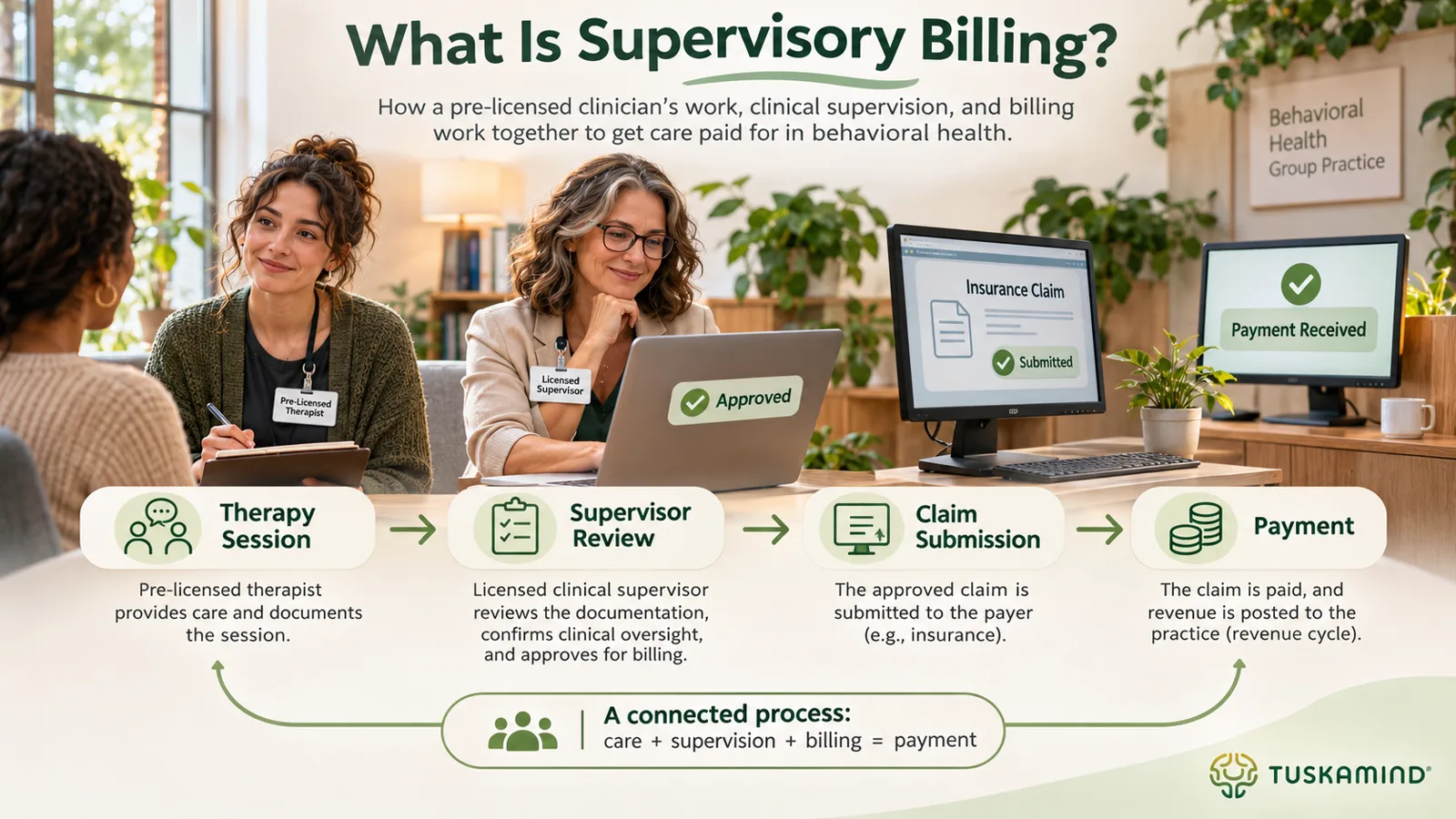
In behavioral health, supervisory billing generally refers to an arrangement in which a qualified, licensed and enrolled clinician assumes responsibility for certain services provided by another clinician working under their supervision. This is particularly relevant for pre-licensed therapists who are completing the clinical experience required for independent licensure. Let's say you have a Licensed Professional Counselor (LPC) supervising a Licensed Professional Counselor Candidate (LPCC). The LPCC provides psychotherapy to a client. The LPC oversees the clinical work, reviews documentation, and provides the supervision required under applicable professional standards. Depending on the insurance company, state regulations, provider enrollment requirements, and the terms of the payer contract, that service may be eligible for billing through an approved supervisory arrangement. Notice I said may. Because having a clinical supervisor doesn't automatically mean a service is billable under that supervisor's credentials. And that's where things get interesting.
Supervisory Billing and Incident-To Billing Are Not Interchangeable
The term incident-to comes from Medicare billing regulations. Under qualifying circumstances, Medicare allows certain services provided by auxiliary personnel to be billed as part of the professional services of an eligible supervising practitioner. There are specific requirements involving the supervising professional, the patient's treatment, the individual delivering the service, the practice setting, and the level of supervision.
For Medicare behavioral health incident-to services, general supervision is permitted under applicable federal rules. That doesn't mean every pre-licensed therapist can automatically treat Medicare beneficiaries under another clinician's NPI.
The services still have to satisfy Medicare coverage requirements, state scope-of-practice laws, and applicable practitioner qualifications. Commercial insurance companies and Medicaid programs may have their own supervisory billing policies. This distinction matters because a billing arrangement accepted by one payer may be rejected by another. And receiving payment doesn't necessarily mean the claim was submitted correctly. Sometimes those mistakes aren't discovered until an audit.
What About the Rendering Provider?
Here's another area that causes considerable confusion. The rendering provider identifies the healthcare professional reported as performing or responsible for the billed service under the payer's rules.
The billing provider is the individual or organization submitting the claim and receiving payment. In some approved supervisory billing arrangements, a payer may require the enrolled supervisor to be reported in the rendering-provider field, even when a pre-licensed clinician personally delivered the treatment. Other payers may require the individual treating clinician's information, a supervisor identifier, or a different enrollment arrangement. And the distinction between who actually treated the client and who was reported on the claim must always remain clear in the clinical and administrative records. This is not something a billing department should have to guess. Yet I've seen how easily these details become disconnected when clinical supervision, documentation, credentialing, and billing operate in separate systems.
The Clinical Supervisor Has Responsibilities Beyond Signing Notes
Clinical supervision isn't simply a signature at the bottom of a progress note. It involves clinical oversight, professional development, ethical accountability, and ensuring that clinicians are practicing within their authorized scope. When billing under a supervisory arrangement is permitted, additional documentation and payer-specific responsibilities may apply. A supervisor may need to review treatment plans, monitor clinical progress, verify that appropriate documentation exists, and demonstrate the required involvement in the patient's care. Consider what happens when a pre-licensed clinician completes a psychotherapy session but the associated documentation is incomplete. Perhaps the progress note doesn't adequately support medical necessity. Perhaps the treatment plan is outdated. Perhaps the supervisory review has not been completed. And yet the claim is submitted. The financial risk doesn't disappear simply because the insurance company pays it.
A paid claim is not necessarily an audit-ready claim.
That's something every group practice owner should understand.
What Does This Look Like in a Growing Group Practice?
Imagine managing 30 clinicians, several of whom are pre-licensed and working under different supervisors. Now imagine managing 100. You have multiple supervisor relationships, documentation requirements, payer-specific billing rules, and hundreds or thousands of insurance claims moving through the system every month. Someone has to keep track of which clinician treated the client, who supervises that clinician, whether the payer permits the billing arrangement, whether the documentation is complete, and whether the claim is ready for submission. That's a lot of moving parts. And frankly, I don't think practice owners should have to rely on spreadsheets, sticky notes, and a collection of disconnected software applications to manage them.
But many do.
Why I Built Supervisory Billing Into TuskaMind
When I began designing TuskaMind, I knew I didn't want to create another EHR that treated clinical supervision as an afterthought. I wanted a platform that understood the structure of a behavioral health group practice. That means recognizing different clinician roles, connecting supervisors with their supervisees, supporting documentation review, managing supervisory workflows, and bringing those relationships into the billing process.
TuskaMind was designed with these connections in mind. Rather than treating the clinical record and the insurance claim as unrelated administrative events, the platform brings clinical workflows and revenue cycle management together.
Our goal is to give practices better visibility into who provided a service, who is responsible for supervisory oversight, and what still needs attention before a claim moves forward. Nellie, TuskaMind's AI assistant, adds another layer of support through clinical documentation assistance and workflows designed to identify issues that warrant human review. Of course, software cannot decide that a payer permits supervisory billing when the payer's rules say otherwise. And AI should never replace the judgment of a qualified clinical supervisor or billing professional. But technology can help reduce the administrative confusion surrounding these processes.
That's an important distinction.
A Few Things I Would Tell Any Group Practice Owner
If you have pre-licensed clinicians providing services to insured clients, understand the billing requirements before accepting those clients. Not after the first denial. And certainly not after an audit.
Verify the following:
Whether the payer permits services provided by pre-licensed clinicians under an approved supervisory arrangement.
Which professionals are eligible to supervise and bill for those services.
Whether specific enrollment, credentialing, or contractual requirements apply.
How the actual treating clinician and supervising professional must be identified on claims.
What clinical documentation and supervisory involvement the payer requires.
Whether those requirements differ for Medicaid, Medicare, and commercial insurance.
I'd also recommend keeping written documentation of payer guidance and reviewing it periodically. Insurance rules change. Provider enrollment requirements change. And what worked for your practice two years ago may not be appropriate today.
Supervisory Billing Shouldn't Be This Complicated
Here's what I find frustrating about the whole process. Pre-licensed clinicians are an essential part of the behavioral health workforce. They provide needed services while developing their professional skills under clinical supervision. Group practices provide the infrastructure to make that possible. But the administrative systems supporting these arrangements haven't always kept pace with how behavioral health organizations actually operate.
Instead, practice owners are often left interpreting payer requirements, tracking supervision separately, reviewing documentation manually, and trying to make their billing software understand the difference between a licensed clinician and someone practicing under supervision. It's an enormous amount of administrative effort for something that should be better organized.
And that's one of the reasons I developed TuskaMind. I believe technology should adapt to the way behavioral health practices work, rather than requiring clinicians and administrators to constantly adapt their workflows to the limitations of their software.
Clinical supervision and billing are connected. Our technology should recognize that.
Because ultimately, the purpose of a good EHR isn't simply to store clinical records or submit insurance claims. It's to help the people delivering care run a clinically responsible, financially sustainable practice. And if we can accomplish that without making everyone miserable in the process, even better.
Are you managing pre-licensed clinicians in your group practice?
What's been your biggest challenge with supervisory billing: insurance requirements, documentation, supervisor approvals, or claims processing? I'd be interested in hearing your experience.
Learn more about TuskaMind: https://tuskamind.com
Related reading: How to Set Up a Supervisory Billing Claim, Optum U5 vs. Colorado Medicaid U9 and supervisory billing in TuskaMind.
Disclaimer: This article is educational and does not constitute billing or legal advice. Supervisory billing requirements vary by payer, state, service, provider qualifications, and contract. Always verify applicable requirements before submitting claims.
