
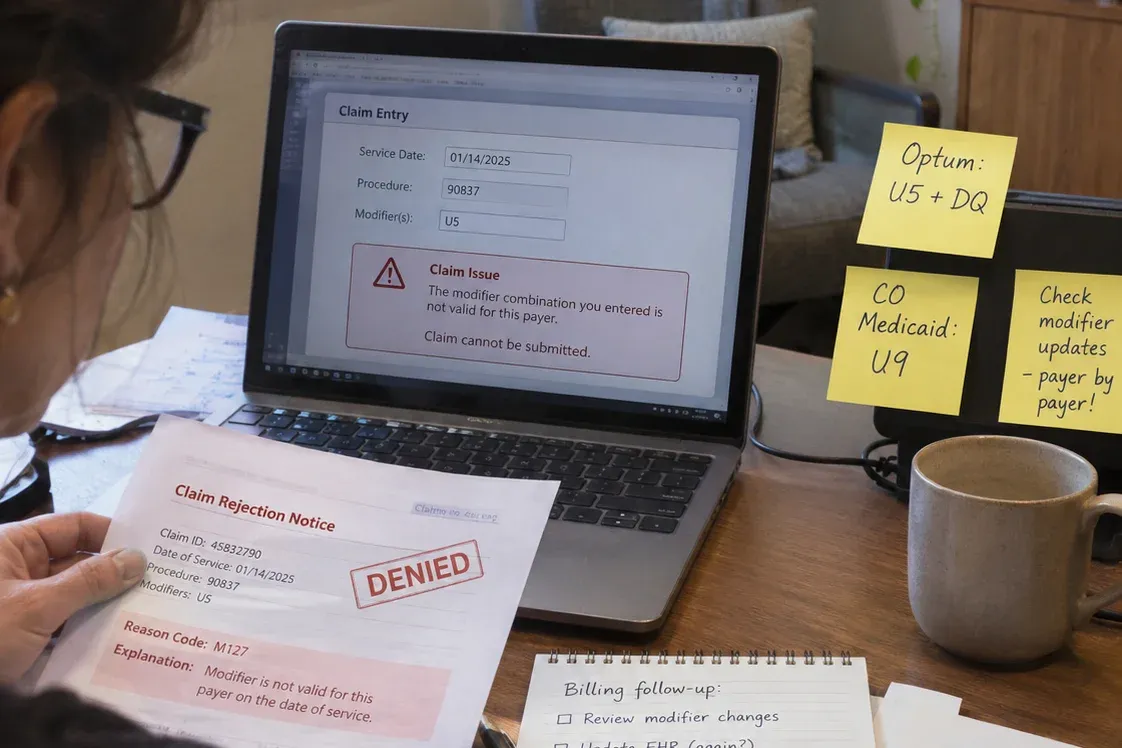
Optum U5 vs. Colorado Medicaid U9: Is Your EHR Using the Right Supervisory Billing Rules?
Let's talk about two little modifiers.
U5 and U9.
They look almost identical. But use the wrong one on the wrong insurance claim, and your billing team may have another problem to investigate. And we're not even finished. Optum also requires something called the DQ qualifier for qualifying supervisory billing claims.
So now we have two modifiers, one qualifier, multiple insurance programs, different states, and rules that change over time. Wonderful! As if running a behavioral health group practice wasn't complicated enough. Here's the problem. A pre-licensed therapist may provide the same type of psychotherapy service to two clients. One has Optum commercial insurance, while the other has Colorado Medicaid. Both services are delivered under an appropriate, qualifying supervisory arrangement. Both progress notes are completed and signed. But the insurance claims may require different information.
Optum Commercial requires U5 and DQ under its supervisory billing policy. Colorado Medicaid requires U9 for applicable services delivered under rendering provider oversight.
The question is whether your EHR knows the difference, or whether your billing team has to remember it.
What Is the Difference Between Optum U5 and Colorado Medicaid U9?
The key difference is the insurance program and its billing policy. For qualifying outpatient services performed under supervision, Optum Commercial requires modifier U5, along with the DQ qualifier and supervising-provider information. Health First Colorado, Colorado's Medicaid program, requires modifier U9 on applicable behavioral health claims for services delivered by pre-licensed clinicians or unlicensed professionals beginning July 1, 2026. These requirements are not interchangeable.
U5 identifies supervised outpatient services under Optum's commercial reimbursement policy. U9 identifies applicable services delivered by pre-licensed or unlicensed professionals under Colorado Medicaid's requirements.
And a payer's published requirements must be applied to the correct plan. That last part is important. Just because a patient's insurance card says UnitedHealthcare doesn't automatically tell you which set of rules applies. You still need to identify the actual insurance product.
What Does Optum Require for Supervisory Billing?
Optum's supervisory billing policy took effect October 1, 2024, for qualifying commercial outpatient behavioral health services.
Its official billing guide requires the following:
Modifier U5: Included on each service line rendered under the qualifying supervision arrangement.
DQ qualifier: Used to identify the supervising provider on the claim. Line 19.
Supervisor information: The supervising clinician's name, credentials, and NPI must be reported in the required claim fields.
The policy also requires an appropriately qualified and Optum-approved supervising clinician.
That's more information than simply placing someone's NPI in the rendering-provider field.
And it's why a general "Bill Under Supervisor" checkbox may not be enough to support every payer.
Where Does the DQ Qualifier Go on an Optum Claim?
For a paper CMS-1500 claim:
Box 17 contains the DQ qualifier and the supervisor's name and credentials.
Box 17b contains the supervisor's NPI.
Box 24D contains the U5 modifier on each qualifying supervised service line.
For electronic professional claims, the supervisor information belongs in the 837P claim-level. Optum's instructions also specify that the services reported under supervision on the same claim must have the same supervisor.
If different supervisors were responsible for different services, separate claims are required under that guidance. These are the kinds of details that may not be obvious to someone looking at the appointment calendar. But they matter when the claim is transmitted.
Source: Optum Reimbursement for Supervisory Services Billing Reference Guide
Which States Allow Optum Supervisory Billing?
Here's another detail that deserves attention too. Optum's commercial supervisory billing policy specifically addresses California, Colorado, Iowa, and Massachusetts.
Effective October 1, 2024, qualifying in-network and out-of-network providers in these four states may submit claims under the policy, subject to applicable state regulations, eligibility, and plan requirements. What about the other states? According to Optum's published guide, eligibility is more restricted. Certain contracted providers or groups may qualify when they already have supervisory billing authorization in their agreements or other written approval from Optum. That means a group practice in Colorado cannot automatically assume that a similar practice in Texas, Florida, or another state has the same reimbursement rights.
And an EHR serving practices nationwide shouldn't assume it either, though their interface must make the addition of these variables available.
State-specific billing rules aren't optional details. They're part of determining whether a claim is appropriate for submission.
What Is Colorado Medicaid Modifier U9?
Now let's look at Colorado Medicaid.
In 2026, the Colorado Department of Health Care Policy and Financing introduced a new modifier requirement for applicable behavioral health services delivered by pre-licensed clinicians and unlicensed professionals. Beginning with dates of service July 1, 2026, billing providers must report modifier U9 on qualifying claim lines.
This applies to the relevant services under Health First Colorado's Rendering Provider Oversight policy. This, of course, includes all regions or RAEs. Let's use a practical example. A Licensed Professional Counselor Candidate provides a qualifying psychotherapy session under an eligible enrolled rendering provider's oversight. The claim must follow the Medicaid requirements applicable to that arrangement, including U9 when required.
Now compare that with a qualifying Optum commercial supervisory claim. That may require U5, DQ, and the supervising clinician's information. Same general type of therapy. Different payer. Different billing requirements.
And here's why that matters.
If your EHR automatically applies one modifier to every supervised appointment, it's not handling these differences correctly. Claims will be denied if the qualifier is missing.
What Happened to Colorado Medicaid's Box 19 Requirement?
This is an especially useful example of how billing requirements change. Colorado originally planned to require additional service-provider information in Box 19 of the CMS-1500 claim. The requirement was delayed after HCPF received feedback, including concerns about EHR functionality. In October 2026, HCPF announced it would not move forward with the statewide Box 19 requirement. However, the U9 modifier requirement remains in effect.
And HCPF advised providers to verify whether their Regional Accountable Entities have additional rules. So consider what happens when an EHR is configured to facilitate a requirement that the state subsequently withdraws. Are you able to add or delete this change? Or does it continue blocking claims because someone hasn't entered information that's no longer required under the statewide policy?
Otherwise, the practice is left compensating for outdated software.
Source: Health First Colorado Behavioral Health Updates — October 2026
What About the Rendering Provider's NPI and Taxonomy?
There's another Optum update worth knowing. Optum announced additional NPI and taxonomy reporting requirements for commercial behavioral health claims in 2026. The announcement addressed identifying the billing provider and rendering provider, including their NPI and taxonomy information. These requirements are separate from the U5 and DQ supervisory billing instructions. And they matter because the billing provider, rendering provider, and supervising provider are not necessarily interchangeable roles. An EHR should distinguish each role and determine which information belongs on the claim under the applicable requirements.
The wrong NPI in the wrong field can create a claim problem even when the clinical documentation itself is appropriate. The exact enforcement date and any subsequent implementation changes should be confirmed using Optum's current guidance.
Why This Gets Complicated for Growing Group Practices
Imagine a mental health practice with thirty clinicians. Some are independently licensed. Others are pre-licensed. Several clinical supervisors oversee different clinicians. The practice accepts Optum Commercial, Colorado Medicaid, and other commercial insurance plans. Now imagine asking the billing department to remember every combination of:
Clinician licensing status.
Payer and insurance product.
State requirements.
Supervising-provider eligibility.
Rendering-provider designation.
Required modifiers and qualifiers.
Effective dates for policy changes.
That's a lot of information. And here's what makes the problem more frustrating. Much of that information already exists somewhere inside the practice's EHR. The clinician's credentials are stored in one area. The payer is identified in another. The supervising relationship may be maintained in a separate workflow. And the claim is generated somewhere else. Why should the billing team have to manually connect information that the software already maintains?
This is where I think behavioral health EHR systems should be doing more.
Can an EHR Prevent Claims From Using the Wrong Modifier?
A well-designed EHR can help. But only if the underlying payer rules are accurate, maintained, and properly applied. For example, an EHR could identify that: A pre-licensed clinician delivered a qualifying service. The client has an Optum commercial plan. The applicable supervisory billing arrangement requires U5 and DQ. The supervisor's required information is missing. Instead of sending the claim without that information, the system could flag it for correction.
For an eligible Colorado Medicaid encounter, the system could check for U9 based on the date of service. That's useful automation. Not because the software is replacing the biller. But because it's helping the biller recognize a preventable error. And remember, a missing modifier isn't the only concern. A claim can contain the correct U5 modifier and still be inappropriate if the clinician, supervisor, service, or insurance arrangement does not meet the payer's requirements.
Correct claim formatting does not automatically establish reimbursement eligibility.
Why Effective Dates Matter
Here's something that often gets overlooked. An insurance company announces a new requirement. Your billing system is updated. But what happens when your biller submits an older date of service? Should today's rules automatically apply? Not necessarily. A rule effective July 1, 2026, may not apply to a service delivered in May. A payer policy effective October 1, 2024, may have different requirements from claims submitted under an earlier arrangement. An EHR should ideally maintain payer-rule effective dates and help distinguish which requirements applied to each service.
Otherwise, the practice risks applying current requirements to historical claims without verifying whether that's correct. This becomes especially important when correcting or resubmitting older claims. An audit-ready billing process needs more than knowing the current rule.
It needs to know which rule was applicable to the service under review.
What Should You Ask Your EHR Vendor?
If you're running a practice with pre-licensed clinicians, here's a question I would ask during an EHR demonstration:
"Can your software distinguish Optum's U5 and DQ requirements from Colorado Medicaid's U9 requirement automatically?"
Then go a little further. Ask whether the system can identify the correct supervising-provider information for Optum. Ask whether it supports the electronic 837P supervising-provider loop. Ask whether requirements can differ by insurance product and state. Ask whether billing-rule changes can be assigned effective dates. And ask what happens when a payer withdraws or changes a requirement. Don't settle for being shown a screen where someone can manually enter a modifier. That proves the software can accept two characters. It doesn't prove that the system understands the billing workflow.
There's a rather substantial difference.
Why This Matters to TuskaMind
I'm a psychotherapist and group practice owner. And I've spent years dealing with the operational challenges of employing pre-licensed clinicians while managing several insurance contracts. I've learned that supervisory billing isn't simply about having an eligible supervisor. It's also about accurately reporting the service, the provider relationships, and the information required by each payer.
That's one of the reasons I started building TuskaMind.
TuskaMind is a behavioral health EHR and revenue cycle management platform designed around the needs of mental health professionals and growing group practices. Our platform connects clinical documentation, supervision-related workflows, and insurance billing. We're continuing to strengthen payer-specific claim validation so billing professionals can identify missing or inconsistent information before submission. I built TuskaMind to solve the operational billing and supervision problems I deal with daily. Most EHRs are built by software engineers and billing agents who have no real experience with supervision workflows.
For me, the goal isn't to create another dashboard. It's to make the information already maintained by the practice more useful. It is meant to solve real life problems that group practice owners deal with daily.
Because a group practice shouldn't need to hire another person simply to remember which payer wants U5, which one requires U9, and where the supervisor's NPI belongs.
Frequently Asked Questions
Does Optum require modifier U5 for supervisory billing?
Yes. Optum's published commercial policy requires U5 on each qualifying outpatient service line delivered under the applicable supervisory arrangement.
What is the DQ qualifier in Optum billing?
DQ identifies the supervising provider. Under Optum's commercial supervisory billing instructions, DQ accompanies the supervisor's required information on the claim.
Where does the Optum supervising provider's NPI go?
For qualifying paper CMS-1500 claims, the supervisor's NPI is reported in Box 17b. Electronic professional claims use the applicable claim-level supervising-provider information in Loop 2310D.
Which states are included in Optum's supervisory billing policy?
The published policy expressly includes California, Colorado, Iowa, and Massachusetts. Eligibility in other states is more restricted and may depend on existing contracts or written approval.
Source: Optum Reimbursement For Supervisory Services Billing Reference Guide
Does Colorado Medicaid require U5 or U9?
Health First Colorado requires U9 for applicable behavioral health services delivered by pre-licensed or unlicensed professionals beginning July 1, 2026. Optum Commercial's U5 requirements should not be automatically applied to Medicaid claims.
Is Colorado Medicaid still requiring Box 19 for pre-licensed clinicians?
HCPF announced in October 2026 that it would not proceed with the planned statewide Box 19 requirement. Providers should verify additional requirements with their contracted Regional Accountable Entities.
Can an EHR automatically apply supervisory billing modifiers?
An EHR can support rules-based modifier validation or assignment when correctly configured. But payer eligibility, clinician credentials, contract requirements, and effective dates must be verified. Automation does not guarantee payment or compliance.
Final Thoughts: Your EHR Should Know Which Insurance Rules Apply
Optum Commercial requires U5 and DQ for qualifying supervisory billing.
Colorado Medicaid requires U9 for applicable services under rendering provider oversight.
Other states and insurance products have different requirements.
And those requirements can change.
For group practices, this creates an administrative problem that cannot be solved simply by completing progress notes and having the right supervisor assigned.
The claim must also accurately reflect the applicable billing rules.
I believe behavioral health EHR systems should help connect those responsibilities.
Because clinicians have enough to do.
Supervisors have enough to do.
And billing teams shouldn't have to memorize an ever-changing collection of modifiers, qualifiers, and insurance policies.
Your EHR should help your practice keep up with payer requirements, not wait until a claim gets denied to discover what's changed.
That's the kind of connected billing workflow we're continuing to develop with TuskaMind.
Explore TuskaMind and learn about our approach to clinical supervision and behavioral health revenue cycle management.
