
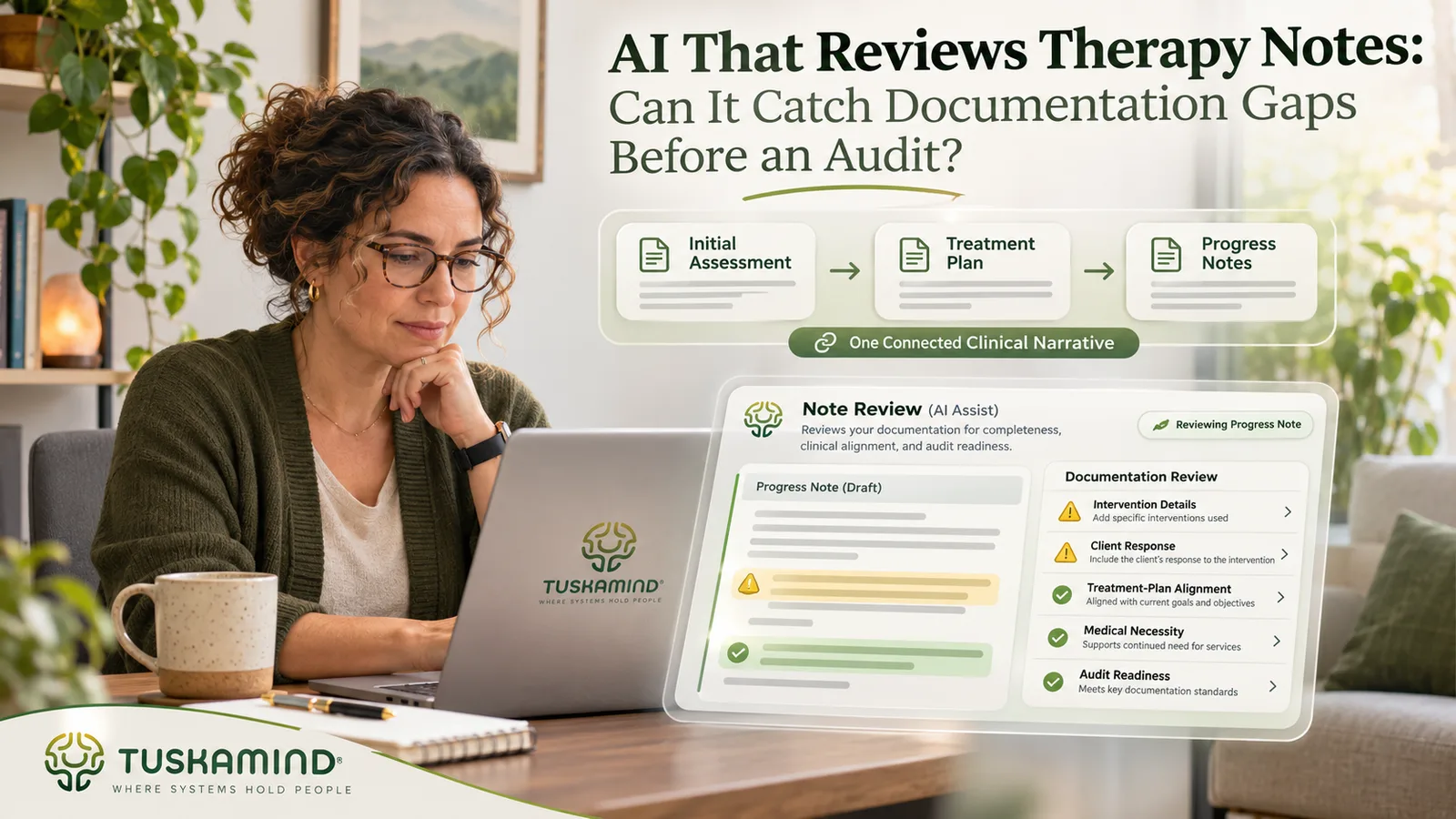
AI Therapy Note Review: Catch Documentation Gaps
AI clinical documentation review for therapists: medical necessity, treatment-plan alignment, clinical supervision, and accurate progress notes.
By Zina Ortiz, MA, LPC | Psychotherapist, Group Practice Owner, and Founder of TuskaMind
Published November 2026
Here's a question I think every mental health group practice owner should ask: Does your EHR know the difference between a completed progress note and a clinically meaningful one?
A therapist finishes a session, writes a note, signs it, and moves on. The EHR says 'Complete.' Wonderful. But what if the note does not identify the therapeutic intervention, describe the client's response, or connect the session to the treatment plan?
The green checkmark looks reassuring. The clinical record, not so much.
I've spent years managing a behavioral health group practice, reviewing clinical documentation, and dealing with insurance requirements. I've learned that a signed note is not automatically an audit-ready note. Sometimes a record contains plenty of words and very little explanation of the actual treatment.
This is where AI clinical documentation review becomes interesting. Not AI replacing the therapist. Not AI inventing a perfect-sounding note. An assistant that helps us see what may be missing while we can still address it appropriately.
Quick answer: Yes, AI can help flag potential documentation gaps before an audit, including unclear interventions, limited treatment-plan alignment, missing client responses, and inconsistencies across records. But AI cannot establish that undocumented care occurred, make independent clinical judgments, or guarantee that an insurer will approve the record.
AI Note Writing vs. AI Clinical Documentation Review: Two Different Jobs
Most people hear 'AI for therapy notes' and immediately think of software that drafts a progress note. That can be helpful. Therapists certainly have better things to do than spend every evening catching up on paperwork.
But writing a note and reviewing a note are not the same thing. One helps produce a draft. The other asks whether the clinical information is accurate, sufficient, and connected to the rest of the treatment record.
AI note-writing assistant | AI clinical documentation reviewer |
|---|---|
Helps organize a draft from available session information | Examines an existing record for possible gaps or contradictions |
May format a note as SOAP, DAP, BIRP, or narrative | Looks for relevant clinical elements and treatment-plan connections |
Can reduce time spent drafting | Can reduce preventable review and correction work |
Still requires the clinician to verify every statement | Still requires the clinician to evaluate every finding |
An AI-generated paragraph can sound beautifully professional and still say very little. Therapists aren't auditioning for a literary award. The clinical record should explain the care actually provided.
The American Psychological Association's guidance on evaluating AI scribes is a useful starting point for clinicians considering AI documentation tools. Its broader ethical guidance for AI in professional practice emphasizes human oversight and responsible use.
What Documentation Gaps Can AI Help Identify in Therapy Notes?
An AI reviewer is most useful when it asks specific, relevant questions instead of producing an avalanche of warnings. Here are seven issues I would want it to recognize.
1. The intervention is missing or too vague
A note says: 'Client discussed conflict with partner. Therapist provided supportive therapy.'
All right. But what did the therapist actually do? Was there cognitive restructuring, emotion-regulation work, skills practice, trauma-focused processing, reflective exploration, or another intervention?
An AI review can ask the clinician to clarify the therapeutic work if it isn't evident. It should never choose an intervention and insert it as though it happened.
2. The client response is not documented
Describing an intervention is helpful. Describing how the client responded may be equally important to understanding the session. Did the client practice a skill, demonstrate insight, have difficulty engaging, or report continued distress?
'Client was engaged' may be true, but it does not always explain the clinical response. Good documentation is specific enough to make the treatment understandable, without turning a progress note into a novel.
3. The progress note has lost its connection to the treatment plan
The Initial Assessment identifies severe anxiety and avoidance. The Treatment Plan calls for exposure-based work and emotional regulation. The progress note describes a session about work stress, but never explains which treatment goal or objective the work addressed.
An AI reviewer can flag the missing connection and invite the clinician to explain it. This is the golden thread of clinical documentation: the reason treatment began, the goals developed, and the services provided should relate to one another.
For a deeper look at the relationships among these records, see Nellie AI's connected documentation approach.
4. Medical necessity is asserted but not explained
Writing 'medically necessary' in a progress note does not, by itself, explain why treatment was appropriate. The documentation may need to show relevant symptoms, functional difficulties, clinical reasoning, and the purpose of ongoing services.
The CMS behavioral health documentation guidance explains the importance of complete, accurate records that support claims. Requirements vary by payer and program, but a note should not expect the words 'medical necessity' to do all the work.
5. The assessment, treatment plan, and note contradict one another
Perhaps the assessment identifies a serious concern that the plan never addresses. Or several progress notes indicate that a treatment objective was achieved, while the plan remains unchanged for months.
An AI review can help clinicians notice that something may need to be clarified or updated. It cannot decide, without clinical judgment, that a diagnosis should be added, removed, or treated differently.
And here's a detail worth remembering: a progress note does not need to address every diagnosis at every appointment. One clinically relevant diagnosis or treatment target may be entirely appropriate for a particular session. An intelligent reviewer should recognize what is already supported instead of generating repetitive alerts.
6. The note and the billed service do not tell the same story
A note may not support the reported duration, modality, or service details. Those are meaningful differences when a billing team prepares a claim.
An AI-assisted review can flag a possible discrepancy for verification. It should not automatically decide the correct CPT code or change the claim without an appropriate human review and the applicable payer rules.
This matters especially in practices using supervisory billing workflows, where the clinician who provided the service, required clinical oversight, and billing provider details must be handled accurately.
7. A safety statement appears without supporting documentation
I pay particular attention to this one. Imagine a note that automatically prints 'Risks: None' when the clinician never documented a risk assessment for that session.
That is not a harmless formatting issue. It makes a clinical assertion that may not have been assessed or recorded.
An AI reviewer can call attention to missing or inconsistent risk information and direct the clinician to review it. It should not manufacture reassuring findings. If there is a genuine safety concern, the clinician must decide what assessment, response, and documentation are required.
The Three-Document Test: Initial Assessment, Treatment Plan, and Progress Notes
Here is what makes the clinical record more than a collection of completed forms.
The Initial Assessment establishes the clinical foundation: presenting concerns, symptoms, relevant history, functional impact, diagnostic reasoning, and need for treatment.
The Treatment Plan translates those needs into goals, measurable objectives, and appropriate interventions.
The Progress Notes document what occurred during treatment: therapeutic interventions, client responses, progress, setbacks, and changing circumstances.
But treatment evolves. A client may improve, new symptoms may emerge, or a particular intervention may stop being effective. The treatment plan and assessment should remain clinically relevant as the record develops.
That's the difference between an EHR that stores three documents and an EHR that helps connect them. Nellie AI by TuskaMind reviews relevant signed progress notes over time, helps identify developments, and prepares suggested updates to assessments and treatment plans with references to the relevant notes and dates of service. The clinician reviews, revises, approves, or rejects those suggestions.
One client. One connected clinical story. Not three separate forms politely ignoring one another.
A Realistic Example: What an AI Note Review Should Actually Do
Let's use a fictional client. The Initial Assessment documents generalized anxiety, difficulty concentrating at work, and avoidance of difficult conversations. The Treatment Plan includes a goal of improving emotion regulation and reducing avoidance.
After a session, the clinician writes:
Draft note: "Client discussed ongoing workplace anxiety. Therapist reviewed coping skills. Client will continue therapy."
The note is not necessarily false. But it leaves useful questions unanswered. What skill was reviewed? Was it practiced? How did the client respond? Was the intervention connected to the treatment objective? What happened that supports continued care?
A responsible AI reviewer might say: 'Consider clarifying the intervention provided, the client's response, and the relevant treatment-plan objective.'
Now the clinician looks back at the work actually completed. If the therapist guided diaphragmatic breathing and the client practiced it during the session, those facts can be documented accurately. If that did not occur, it should not be added simply to satisfy the software.
The goal is not to make every note longer. It is to make the note more clinically meaningful.
That's the kind of distinction that matters when an insurance payer requests documentation and the practice needs to explain what was done and why.
Can AI Documentation Review Reduce the Burden on Clinical Supervisors?
Yes, if the findings are timely, relevant, and directed to the right person.
Imagine a supervisor responsible for eight pre-licensed clinicians. Those clinicians produce progress notes, assessments, and treatment plans every week. If the supervisor has to open every record to find the same missing intervention or outdated objective, much of the day becomes administrative proofreading.
An AI review can help clinicians see potential issues before they submit the document for required review. This can reduce repeated corrections and allow supervisors to focus more on clinical reasoning, professional development, and oversight.
But the system must understand context. A session devoted to rapport building, further assessment, or stabilization is not automatically inadequate. A note addressing one relevant diagnosis is not automatically incomplete. More alerts do not mean better supervision. Sometimes they just mean more things to ignore.
TuskaMind connects clinical supervision queues and co-signature workflows with Nellie's documentation review, so clinicians and supervisors can work within a connected environment. Where a review or signature is required, it should be captured accurately, not assumed.
Before You Trust AI With Therapy Notes, Ask About Privacy and Human Oversight
AI documentation software deals with some of the most sensitive information in a healthcare practice. That deserves more than a reassuring privacy badge on a sales page.
Ask what clinical information the AI receives, how long it is retained, which staff can access it, how the vendor handles subcontractors, and whether the information is used for model training. Review the vendor's contracts and safeguards carefully.
HHS guidance on HIPAA and cloud computing explains why appropriate business associate agreements and security safeguards matter when a vendor processes electronic protected health information.
Also, therapy progress notes are not automatically the same thing as separately maintained psychotherapy notes under HIPAA. The latter receive special protections. The HHS explanation of psychotherapy notes is a useful reference when evaluating which records a tool can access or process.
Finally, require a meaningful human review. The clinician must be able to see what the AI flagged, understand why, correct the actual record appropriately, and reject a suggestion when it doesn't fit the clinical facts.
Does AI Make Therapy Notes Audit-Ready?
Let's separate what AI can help with from what it cannot promise.
AI may help identify potential documentation gaps early. It may bring the relationship among assessments, plans, and notes into focus. It may help supervisors prioritize records needing attention. Those are useful forms of support.
But AI cannot guarantee a successful payer audit, establish medical necessity independently, or repair a historical record by rewriting what happened. Signed clinical documentation must remain accurate, and legitimate amendments should preserve the history of the record.
The APA record-keeping guidelines and CMS guidance on self-auditing behavioral health documentation both reinforce the importance of maintaining records that support the actual professional service.
Think of AI review as an early warning system, not a guarantee. The fire alarm can tell you something needs attention. It cannot replace the person responsible for responding.
Seven Questions to Ask Before Buying an AI Therapy Note Reviewer
I would give every vendor a fictional case and ask them to demonstrate the actual workflow, not just show a slide listing features.
1. Does the AI review an existing note, or only generate a new one? Ask for a note with a missing intervention and see what happens.
2. Can it connect the Initial Assessment, Treatment Plan, and Progress Notes? Ask how it references earlier signed documents and dates of service.
3. Does it explain why a finding matters? A useful flag should point to the issue, not simply announce "audit risk."
4. Can the clinician accept, reject, or clarify a suggestion? Clinical judgment must remain with the clinician.
5. Does it avoid false alarms? Test a session focused on rapport, one diagnosis, or a legitimate change in treatment focus.
6. How are findings, signatures, and amendments recorded? Ask what the EHR retains and what can be retrieved later.
7. How does the tool protect clinical information? Ask about HIPAA responsibilities, permissions, data handling, and contractual safeguards.
For a broader examination of what makes an EHR genuinely prepared for audits, read Is Your Mental Health EHR Really Audit-Ready?. This article focuses on AI reviewing the clinical content itself, not on every aspect of an EHR audit trail or records export.
Why We Built Nellie AI Into TuskaMind
As a psychotherapist and group practice owner, I've seen how easily clinical information gets scattered across assessments, treatment plans, progress notes, supervision reviews, and billing processes.
I didn't want another AI tool that simply turns a few words into a polished note. I wanted something that could help clinicians recognize what matters in the records they already create.
That is the purpose behind Nellie AI, TuskaMind's integrated clinical documentation assistant. She supports note preparation and documentation integrity review, and helps connect clinical developments across the Initial Assessment, Treatment Plan, and Progress Notes.
Nellie can bring potential inconsistencies and missing clinical information to a clinician's attention. She can support assessment and treatment-plan updates based on relevant signed notes. She does not independently diagnose, invent clinical events, or decide whether an insurance claim must be paid.
And because TuskaMind also supports clinical supervision and connected billing workflows, the purpose is to make documentation review part of normal practice operations, not a last-minute project after a payer sends a letter.
My position is simple: If AI is going to work with our clinical records, it should help make those records more accurate, coherent, and useful. Not simply more impressive-looking.
Frequently Asked Questions About AI Clinical Documentation Review for Therapists
Can AI review psychotherapy progress notes for missing information?
Yes. Depending on the tool and the information available, AI can flag potential omissions, inconsistencies, unclear interventions, and missing connections to treatment goals. The clinician must evaluate whether the finding is valid.
Is an AI therapy note reviewer the same as an AI scribe?
No. AI scribes generally assist with capturing or drafting information. An AI documentation reviewer examines existing documentation for possible issues. Some platforms support both roles.
Can AI determine medical necessity for mental health treatment?
AI can highlight places where clinical reasoning or supporting information may be unclear. The determination of medical necessity involves clinical judgment and applicable payer requirements; AI should not make that decision independently.
Does every diagnosis need to be addressed in every progress note?
No. A session can appropriately focus on one diagnosis, symptom group, or treatment objective. The note should accurately describe the services provided and remain consistent with the overall course of care.
Will AI documentation review prevent insurance denials or clawbacks?
It may help identify some preventable documentation issues earlier. But payer decisions also involve eligibility, provider enrollment, authorization, coding, policy requirements, and other factors. No AI reviewer guarantees payment or audit results.
Is it safe to use AI with mental health records?
It depends on the vendor, its contractual and technical safeguards, permitted uses of clinical information, professional requirements, and the practice's own risk assessment. Ask for the relevant documentation rather than assuming every AI tool is suitable for protected health information.
Final Thoughts: Catch the Gap Before the Audit Letter
There's a simple difference between a progress note that looks complete and one that accurately explains the care provided.
When we identify missing interventions, limited client responses, outdated treatment goals, or unclear clinical reasoning early, we have an opportunity to improve documentation as part of regular clinical practice. That benefits clinicians, supervisors, continuity of care, and the practice's ability to respond to legitimate record requests.
The best time to identify a documentation gap is before it becomes an audit finding.
I would much rather have a helpful reminder from Nellie today than spend a Friday evening trying to explain a progress note from eighteen months ago. I'm sure most practice owners would agree.
Learn more about Nellie AI and clinical documentation integrity, explore TuskaMind's clinical supervision features, or discover TuskaMind.
About the author: Zina Ortiz, MA, LPC, is a Colorado Licensed Professional Counselor, behavioral health group-practice owner, and founder of TuskaMind. She writes about clinical documentation, supervision, insurance billing, and the operational realities of mental health group practices.
Educational notice: Documentation standards vary by payer, state, service, and professional requirements. AI-assisted review supports, but does not replace, clinician judgment, recordkeeping obligations, privacy protections, or payer-specific review. No software guarantees an audit outcome
