
What If Your EHR Could Tell You Which Progress Notes Need Your Attention?
How Nellie AI helps clinical supervisors identify documentation concerns before approving progress notes
Imagine you're a clinical supervisor responsible for reviewing progress notes from 10 therapists. Some are fully licensed. Others are associate therapists, counseling candidates, clinical social work candidates, or pre-licensed clinicians working toward independent licensure. The notes start coming in. One has incomplete documentation. Another doesn't clearly describe the therapeutic intervention. A third seems inconsistent with the client's treatment plan. The other seven? They may be perfectly fine. But how would you know without opening every single record and reading through it?
Now imagine opening your EHR and immediately seeing which notes have potential issues that deserve closer attention.
That's what we're building with Nellie Clinical Integrity in TuskaMind.
And we've added something particularly useful for clinical supervisors: AI-assisted documentation findings directly inside the supervisor's Approvals dashboard. Not another report to download, or another spreadsheet to maintain. Certainly not another administrative task to add to your already impressive collection.
Why Clinical Supervisors Need More Than a Progress Note Approval Button
Clinical supervision involves much more than checking whether a therapist completed a note. Supervisors help clinicians develop their clinical skills, evaluate treatment decisions, recognize potential safety concerns, and maintain professional standards. For pre-licensed therapists, also known as associate therapists, provisionally licensed counselors, counseling interns, or clinical supervisees, supervision is an essential part of professional development.
The American Psychological Association's Guidelines for Clinical Supervision in Health Service Psychology emphasize professional competence, quality of care, and protection of clients. But let's be practical. Supervisors also have paperwork to review. Lots of it! And when you're supervising multiple clinicians in a busy mental health group practice, it's easy to spend more time searching for problems than addressing them. A progress note might be signed and complete. But does it adequately support the treatment provided?
Does it describe the interventions used? Is the documentation consistent with the client's diagnosis and treatment plan? Are important risk or safety concerns addressed appropriately?
Those are the questions that matter during an audit.
A signature confirms that a document was signed. It doesn't automatically mean that the documentation is clinically sufficient or that is audit ready.
Meet Nellie Clinical Integrity: AI Clinical Note And Audit-Ready Review Built Into TuskaMind
Nellie is TuskaMind's AI-assisted clinical documentation reviewer. Unlike an AI scribe that primarily helps generate notes, Nellie Clinical Integrity examines documentation for potential gaps, inconsistencies, and concerns that may require a clinician's attention. Nellie is designed for clinical note review across the practice, across treatment, including the documentation completed by clinicians working under supervision.
Her Clinical Integrity review evaluates areas such as:
Medical necessity: Does the note provide appropriate support for the services delivered?
Diagnostic support: Is the clinical documentation reasonably consistent with the documented diagnoses and symptoms?
Treatment-plan alignment: Does the note explain how the session relates to the client's treatment needs and goals?
Clinical interventions: Does the clinician describe what therapeutic work occurred?
Client responses: Is the client's participation or response to treatment adequately documented when clinically relevant?
Risk and safety: Are potential safety concerns identified for appropriate clinical review?
Missing or inconsistent information: Is something unclear, incomplete, or potentially contradictory?
The purpose is not to make every progress note look identical. It's to help clinicians and supervisors recognize what might need clarification. Because an incomplete note isn't always obvious. And sometimes a note can look beautifully written while saying very little about the actual treatment or to support the diagnosis.
A New Feature: Nellie's Findings Now Appear on the Supervisor's Approvals Dashboard
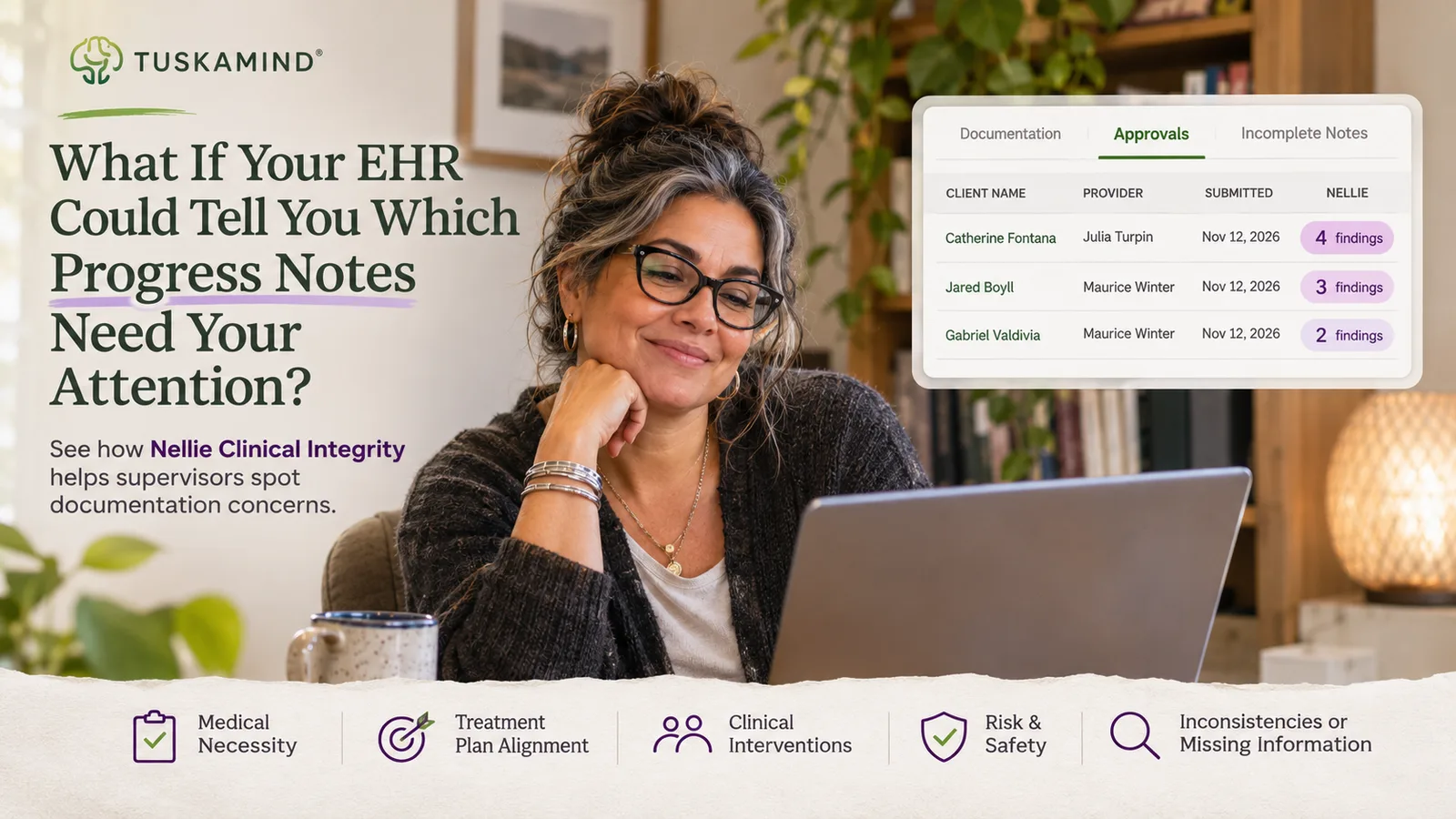
Here's where things get interesting. Inside TuskaMind, supervisors already have an Approvals dashboard for reviewing submitted clinical documentation. We've now added a dedicated Nellie column to that dashboard. When Nellie has identified potential documentation concerns in a reviewed record, the supervisor can see a finding count directly in the Approvals list.
For example, the current interface displays records with:
2 potential findings
3 potential findings
4 potential findings
The supervisor can recognize which records have flagged concerns without opening each progress note first. That doesn't mean the supervisor should skip reviewing other records. It means the supervisor has additional information to help decide where closer attention may be needed. And that changes the workflow. Instead of opening every note with no indication of what to look for, the supervisor can begin with records containing potential clinical documentation issues.
Nellie helps identify what deserves attention before the supervisor approves it.
The supervisor still reviews the clinical record, evaluates the concerns, and makes the final decision.
What Happens When the Supervisor Opens a Flagged Progress Note?
Nellie's Clinical Integrity panel shows the concerns identified during review.
In the current interface, findings include descriptions and severity labels that help explain why a record was flagged.
For example, Nellie may identify:
Potential concern: Treatment-plan alignment
The progress note discusses a topic that doesn't clearly connect to the interventions or goals in the existing treatment plan.
Potential concern: Diagnostic support
The documented session content doesn't clearly explain how treatment relates to the client's identified symptoms or clinical needs.
Potential concern: Missing clinical information
The note describes a therapeutic encounter but may not adequately explain the intervention or the client's response. These findings give the supervisor something specific to evaluate. They also create opportunities for meaningful feedback to the clinician. And that's where clinical supervision should become more useful.
Not Every Flag Means the Therapist Did Something Wrong
This is a difference. Nellie is an AI-assisted reviewer and clinical supervisor assistant. She isn't a clinical supervisor. And she certainly shouldn't be making treatment decisions. Consider a client diagnosed with post-traumatic stress disorder (PTSD). During one session, the clinician focuses on family relationships, emotional support, or establishing trust rather than directly processing traumatic memories. An overly rigid documentation review might flag that session because the content doesn't explicitly discuss trauma symptoms. But does that mean the session was inappropriate? Of course not.
Psychotherapy isn't an assembly line. Clients aren't expected to work through their diagnoses according to a fixed script. A clinically appropriate session may involve building rapport, strengthening the therapeutic relationship, gathering history, developing emotional safety, building emotional language, acknowledging emotions and thoughts, or addressing current stressors.
The Substance Abuse and Mental Health Services Administration's guidance on trauma-informed approaches emphasizes safety, trust, collaboration, and client empowerment. These are important parts of treatment, even when a session doesn't involve a specific trauma-processing intervention. The real documentation question may be whether the clinician clearly explained the therapeutic purpose of the session. Sometimes, after reviewing the full record, the supervisor may determine that the note is already sufficient.
Nellie's job is to raise a question. The clinician's job is to answer it using professional judgment. That distinction is central to how we're developing Clinical Integrity. We're continuing to refine Nellie's reviews so she can better distinguish meaningful documentation gaps from clinically appropriate therapeutic work.
Why Clinical Documentation Matters for Insurance Audits
Let's talk about insurance. According to the Centers for Medicare & Medicaid Services' guidance on behavioral health documentation, clinical records supporting Medicaid-reimbursed services should be complete, accurate, and consistent with applicable medical necessity and billing requirements. CMS also recommends internal self-audits to help identify documentation problems before an external review occurs. That makes sense, right? An insurance payer reviewing a claim doesn't have the benefit of sitting in the therapy session. It relies on documentation to understand what services occurred and whether the claim is supported. If the record doesn't adequately describe the treatment, the practice may have difficulty demonstrating medical necessity.
For a mental health group practice, that can create unnecessary exposure to:
Documentation deficiencies
Insurance audit findings
Requests for clarification or additional records
Denied claims
Post-payment reviews and potential recoupments
Not every documentation concern leads to one of these outcomes. And no EHR can guarantee that a payer will accept every record. But recognizing problems earlier gives clinicians an opportunity to address legitimate gaps accurately and appropriately.
The goal is not to manufacture better documentation after an audit. It's to maintain better documentation as part of everyday clinical practice, reducing the chances for clawbacks. That's a much more sensible approach.
Why This Matters for Group Practices With Pre-Licensed Clinicians
Now consider a behavioral health practice with 20 or 30 clinicians. Several may be pre-licensed. The practice may employ multiple independently licensed supervisors responsible for different supervisees. Each clinician documents sessions, assessments, and treatment plans. Each supervisor has clinical oversight responsibilities. And the billing department must submit claims according to the applicable insurance requirements. This is where supervision and documentation become directly connected to practice operations.
For example, Colorado Medicaid's Rendering Provider Oversight guidance explains that the responsible rendering provider oversees the treatment delivered by qualifying pre-licensed clinicians and unlicensed professionals. This includes oversight related to medical necessity and the treatment plan. Interestingly, Colorado Medicaid also clarifies that it does not require every note to be countersigned by a licensed clinician. Practices still need appropriate oversight processes, and specific contractual or organizational requirements may differ.
That's an important distinction. Supervision is not simply about collecting signatures. It's about exercising appropriate clinical responsibility. Commercial insurers may have additional requirements.
For example, Optum's Reimbursement for Supervisory Services Billing Reference Guide explains the conditions under which eligible commercial outpatient services delivered under supervision may be reimbursed, including specific claim information requirements. An EHR for pre-licensed therapists should help practices manage these clinical and administrative relationships. But simply having a supervisor's name attached to a clinician isn't enough.
Clinical oversight must be meaningful, and insurance billing must follow the applicable payer rules.
That's why TuskaMind is being developed with supervision workflows, documentation review, and revenue cycle management connected.
What Makes Nellie's Supervisor Review Different From an AI Note Writer?
There's an important difference between writing a progress note and evaluating its clinical content. An AI note-writing tool may help a therapist organize session information into a SOAP, DAP, or other documentation format. That can be useful. But a well-formatted progress note can still contain incomplete or inconsistent information. For example: A progress note may identify the client's diagnosis but fail to describe the therapeutic intervention. A treatment plan may include specific goals that aren't clearly connected to the documented care. An assessment may identify a significant concern that hasn't been adequately addressed in subsequent documentation. A note may describe a session without clearly supporting the service billed.
Those are different problems from grammar or formatting.
Nellie doesn't just help with clinical documentation. She helps supervisors identify which parts of the documentation may need attention.
By bringing potential findings into the existing Approvals workflow, TuskaMind gives supervisors information they can use while completing their normal responsibilities. Rather than making supervisors go looking for problems, the system helps bring possible concerns into view.
Can AI Replace Clinical Supervision?
No. And it shouldn't. Clinical supervision is a professional relationship involving judgment, consultation, education, ethical responsibility, and evaluation of clinical work. AI cannot understand every detail of a therapeutic relationship. It may lack important context. It may misunderstand a clinically appropriate intervention. And it can flag concerns that turn out not to be problems.
The American Psychological Association's ethical guidance on AI in clinical practice emphasizes the importance of human oversight, accuracy, privacy, and professional responsibility. That's exactly the boundary we're maintaining. Nellie can help identify potential concerns. She can bring those concerns to the supervisor's attention. She can support documentation review. But the supervisor remains responsible for clinical decisions and approvals. A useful AI finding should prompt a reasonable question, not force a clinician to change accurate documentation to satisfy an algorithm. And if something wasn't assessed or performed during treatment, AI shouldn't invent it.
How Can AI-Assisted Clinical Integrity Help a Busy Mental Health Practice?
Let's return to that supervisor reviewing 10 progress notes. Without a documentation review tool, the supervisor opens each note, reads the content, compares it with the clinical record, and evaluates whether additional clarification is needed. With Nellie's findings visible in the Approvals dashboard, the supervisor has a way to identify potential concerns earlier in the review process.
That may help a group practice:
Prioritize documentation reviews. Supervisors can see which reviewed records have flagged concerns.
Provide more specific feedback. Rather than telling a supervisee to improve documentation generally, a supervisor can identify an area needing clarification.
Support consistency. Common documentation expectations can be applied across clinicians while allowing individual clinical judgment.
Identify training opportunities. Repeated documentation concerns may reveal where clinicians could benefit from education or additional supervision.
Improve preparation for insurance audits. Potential documentation issues can be addressed during routine workflows rather than first being discovered during a payer review.
Reduce unnecessary back-and-forth. A clear description of the potential concern may make follow-up conversations more productive.
These are intended operational benefits, not promises of a particular time savings or audit result. But for a supervisor managing a substantial caseload of documentation, even improving the organization of the review process can make a difference.
What Should You Look for in an EHR for Clinical Supervision?
If you're evaluating an electronic health record for a mental health group practice that employs associate therapists, interns, or pre-licensed clinicians, consider asking:
Does the EHR identify the treating clinician and the appropriate clinical supervisor?
Can supervisors access submitted documentation through a dedicated approval workflow?
Does the software help identify potential documentation gaps before approval?
Can supervisors review findings in the context of the assessment and treatment plan?
Are clinical roles and permissions appropriate for the organization?
Does the EHR support payer-specific supervisory billing requirements?
Can the practice retrieve historical documentation and relevant approval records for audits?
Does any AI-assisted review preserve human clinical judgment?
A checkbox labeled "Supervisor Approved" doesn't answer all these questions. And an AI note writer alone doesn't either. For practices employing supervised clinicians, the connection between documentation, clinical oversight, and billing is especially important.
Why We're Building This Into TuskaMind
I'm a psychotherapist and group practice owner. I know what it's like to manage clinicians, supervisees, insurance requirements, and clinical documentation. And I know that most supervisors don't need another system giving them more work. They need better information within the work they're already doing. That's why we've brought Nellie Clinical Integrity findings directly into TuskaMind's supervisor Approvals dashboard. The current interface shows potential findings beside submitted clinical notes, allowing supervisors to recognize records that may need closer attention. We're continuing to test and improve Nellie's ability to evaluate clinical context, reduce unnecessary flags, and identify documentation concerns that matter.
The goal isn't to turn psychotherapy into a checklist. It's to help supervisors spend less effort searching for documentation issues and more attention evaluating the concerns that deserve their expertise. Because clinical supervisors should be supervising clinicians. Not spending their afternoons playing hide-and-seek with incomplete progress notes.
Frequently Asked Questions
Can AI review therapy progress notes for documentation errors?
Yes. AI-assisted clinical documentation tools can examine progress notes for potential missing information, inconsistencies, and areas requiring clarification. However, findings must be evaluated by qualified clinicians because AI can misunderstand clinical context.
Is Nellie Clinical Integrity an AI note writer?
Nellie includes clinical documentation assistance, but Clinical Integrity serves a different purpose. It reviews documentation for potential concerns involving medical necessity, treatment-plan alignment, diagnostic support, interventions, safety, and consistency.
Can an EHR show supervisors which progress notes need review?
Yes. TuskaMind's Nellie-enabled Approvals dashboard displays finding counts for reviewed records containing identified concerns. Supervisors can see those indicators before opening the full notes.
Does Nellie review clinical notes automatically?
Nellie is designed to support clinical note reviews across the practice, rather than relying only on manually selected records. Review availability and status depend on the enabled Clinical Integrity workflow. Supervisors remain responsible for completing appropriate clinical oversight.
Can an EHR help supervise pre-licensed therapists?
Yes. An EHR designed for clinical supervision can help manage supervisee relationships, documentation review, approvals, and related workflows. The software supports supervision but doesn't replace the supervisor or change licensing requirements.
Does an EHR with supervisory billing support guarantee insurance reimbursement?
No. Insurance reimbursement depends on the payer's policies, the member's coverage, provider eligibility, accurate claim submission, and clinical documentation. EHR features can support these processes but cannot guarantee payment.
Can AI make psychotherapy notes audit-ready?
AI may help identify potential documentation deficiencies before a record is finalized or reviewed. However, audit readiness depends on accurate records, appropriate clinical care, organizational procedures, and applicable payer requirements. No AI tool can guarantee an audit outcome.
Final Thoughts: Better Clinical Supervision Starts With Better Information
A good clinical supervisor doesn't simply approve notes. They help clinicians think critically, document accurately, and provide appropriate treatment. And a good EHR should support that work. Nellie Clinical Integrity brings potential documentation concerns into the supervisor's existing workflow, helping identify which progress notes may deserve additional attention. Not to replace supervisors. Not to second-guess every therapeutic intervention. And not to make mental health documentation even more complicated. But to give clinical supervisors another useful tool for protecting the quality and integrity of the records they oversee.
What if your EHR could tell you which progress notes need your attention?
With Nellie Clinical Integrity, we're making that possible.
Learn more about TuskaMind and Nellie AI, built for behavioral health clinicians, clinical supervisors, and group practices.
Disclaimer: Nellie Clinical Integrity is an AI-assisted documentation review tool. Findings are suggestions for qualified professional evaluation, not clinical determinations. Features and availability may vary as development and testing continue. TuskaMind does not guarantee insurance reimbursement, regulatory compliance, audit outcomes, or error-free documentation.
