
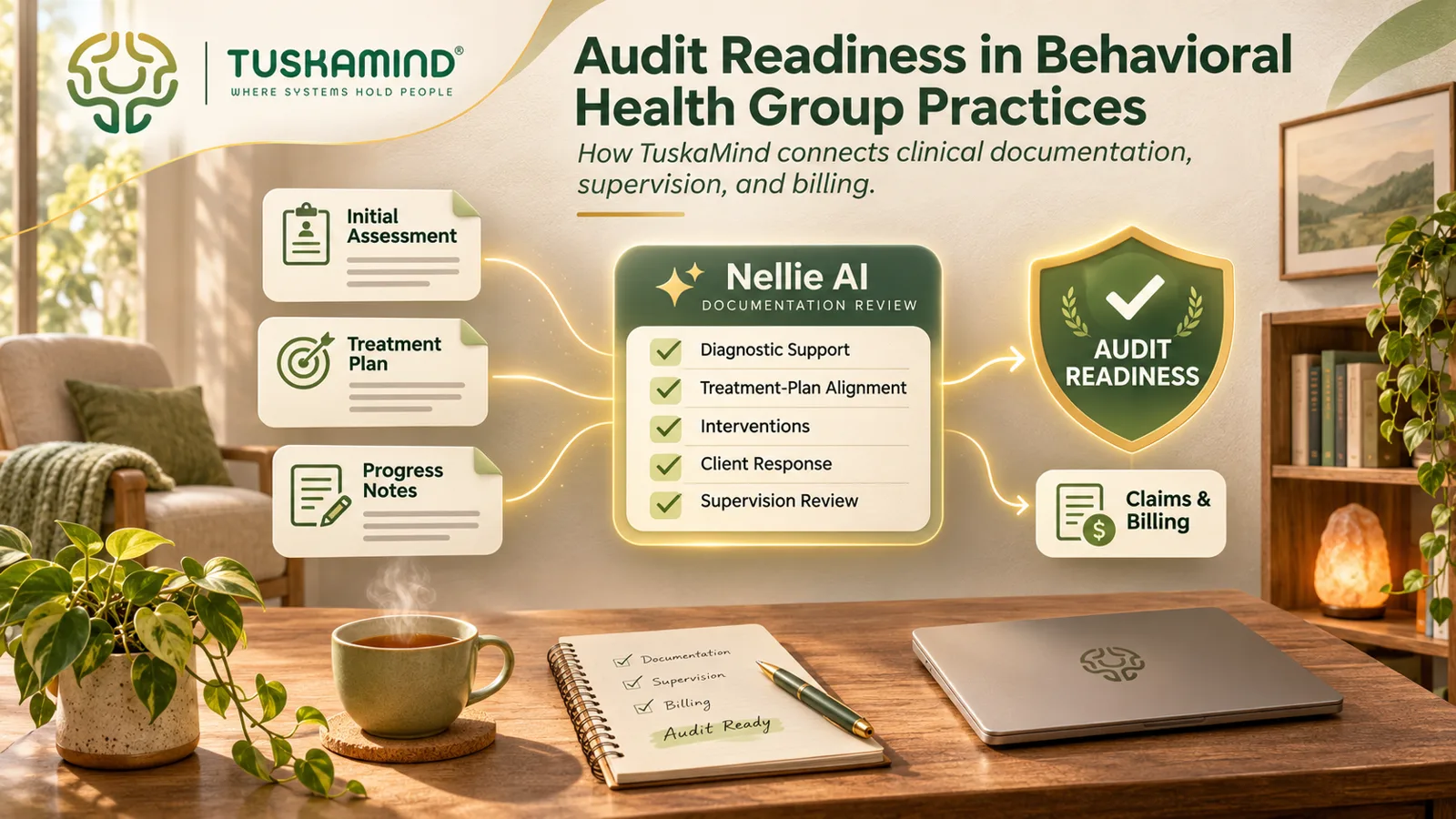
How Nellie AI Supports Behavioral Health Audit Readiness
Clinical documentation, supervision, supervisory billing, and Nellie AI working together to help mental health practices prepare for insurance audits before the request arrives.
Let's talk about insurance audits, again. Every group practice owner's favorite surprise. You open your email and find a letter from an insurance company requesting clinical records for several clients, multiple dates of service, and documentation supporting the claims they already paid.
Now you need initial assessments, treatment plans, progress notes, signatures, and possibly proof of clinical supervision. And depending on the payer, they may also want to know who provided the service, who was responsible for oversight, which provider was identified on the claim, and whether the documentation supports what was billed. There is a deadline. Your clinicians are busy seeing clients.
And your billing team is trying to figure out why a claim from eighteen months ago lists a rendering provider who wasn't the person delivering the therapy. Sound familiar? I've been there, thanks to having worked in an outdated EHR, Theranest. As a psychotherapist and group practice owner, I've learned that having an electronic health record doesn't automatically mean your practice is prepared for an insurance audit.
Storing clinical records is one thing. Being able to demonstrate that those records support the services billed is another. And that difference can become expensive.
What Does Audit Readiness Really Mean for a Mental Health Group Practice?
Audit readiness means a practice can produce accurate, complete, and appropriately maintained records to support the services it provided and billed. For behavioral health group practices, that involves more than progress notes. You also need to consider clinical assessments, treatment plans, medical necessity, professional credentials, supervision, payer-specific billing requirements, and documentation histories. A signed progress note does not automatically establish medical necessity. A supervisor's name in a clinician's profile does not prove that required oversight occurred.
And an insurance claim marked "paid" doesn't necessarily mean the service was billed correctly. The goal is to make these responsibilities work together. This is one of the reasons I developed TuskaMind, a behavioral health EHR designed around clinical supervision, documentation, insurance billing, and the daily operations of growing mental health practices. I didn't want another digital filing cabinet. I wanted a system that could help identify problems before they turned into insurance denials, documentation deficiencies, or repayment demands.
Because finding a problem while a clinician is completing a note is considerably easier than discovering it during an audit two years later.
1. Clinical Documentation: A Signed Note Is Not Necessarily an Audit-Ready Note
Let's start with the progress note. A clinician completes a psychotherapy session and writes: "Client discussed work stress and relationship problems. Therapist provided supportive therapy. Client was engaged." The note is signed. The date is correct. The appointment was completed. Everything looks fine. Except the documentation may not adequately explain what happened clinically. What symptoms were addressed? What therapeutic intervention was provided? How did the client respond? How was the intervention connected to the treatment plan? What supports the medical necessity of the service? These aren't unreasonable questions.
They're the kinds of questions clinical supervisors, documentation reviewers, and insurance auditors ask.
The Importance of Medical Necessity
Medical necessity involves the clinical reasons a service is appropriate under the applicable standard or insurance policy. For psychotherapy, documentation should help explain the relationship between the client's presenting symptoms, functional difficulties, treatment goals, therapeutic interventions, and continuing need for services. Simply writing "medical necessity established" isn't enough if the rest of the record doesn't explain why. It's like writing "excellent treatment provided" and expecting everyone to accept it. I appreciate the confidence. But where's the clinical evidence?
Connecting Initial Assessments, Treatment Plans, and Progress Notes: How Nellie AI Connects All Three Clinical Documents
Nellie isn't designed to look at clinical documents as separate pieces of paperwork. She's designed to understand how they relate to one another. Think about it. A clinician doesn't learn everything about a client during the first appointment. Clinical information develops over time. New symptoms emerge, diagnoses become clearer, treatment goals change, and progress notes capture what happens along the way. So why should the EHR treat each document as though the others don't exist?
Nellie's interconnected documentation workflow is designed around three essential clinical records:
Initial Assessment: Nellie draws from clinician-documented intake information and relevant previous progress notes to help organize the client's history, symptoms, diagnostic findings, and clinical presentation.
Treatment Plan: Nellie uses information from the assessment and relevant progress notes to help clinicians develop meaningful goals, measurable objectives, and interventions connected to the client's identified needs.
Progress Notes: Nellie reviews ongoing documentation in the context of the assessment and treatment plan, identifying potential gaps in diagnostic support, treatment-plan alignment, therapeutic interventions, and client responses.
And the connection doesn't stop there. As treatment progresses, Nellie is intended to help clinicians recognize when new information may warrant updating an initial assessment or revising a treatment plan.
The three documents inform one another. They aren't three separate forms that clinicians complete and forget about.
Of course, Nellie doesn't make clinical decisions independently. Clinicians remain responsible for reviewing the information, confirming its accuracy, and determining what belongs in each record. The purpose is to reduce repetitive documentation, improve clinical consistency, and make the relationship between assessment, treatment, and progress easier to follow. Because clinical care evolves. The documentation should evolve with it. And when an auditor reviews the records, the clinical reasoning should be understandable without having to play detective.
A client's documentation should tell a consistent clinical story.
The initial assessment establishes the presenting concerns, symptoms, clinical findings, diagnosis, and reasons for treatment.
The treatment plan identifies the goals, measurable objectives, and interventions intended to address those needs.
The progress notes document the treatment provided, the client's response, progress toward goals, and changes in clinical presentation.
These documents shouldn't exist as three separate administrative exercises. They should connect. For example, if an assessment identifies significant anxiety, avoidance, and difficulty functioning at work, the treatment plan should address those concerns. Progress notes should then document the interventions used and the client's response. If treatment changes, the documentation should explain why. This connection is sometimes called the golden thread of clinical documentation.
And it is an important part of the philosophy behind TuskaMind.
2. Nellie AI: Identifying Clinical Documentation Gaps Before They Become Audit Problems
This is where Nellie AI comes into the picture. Nellie is TuskaMind's integrated clinical documentation assistant. But I didn't want Nellie to simply write prettier progress notes. There are already plenty of AI tools that can produce a very impressive paragraph. The problem is that an impressive paragraph isn't necessarily clinically sufficient. And sometimes a longer note is simply a longer version of the same missing information. What interested me was something more useful.
Could AI help clinicians recognize documentation problems while they are still working on the record?
Nellie's clinical documentation review is designed to assist with that responsibility.
What Does Nellie Look For?
Nellie can help bring attention to potential issues such as:
Medical necessity: Does the documentation explain the clinical basis for treatment and continued services?
Diagnostic support: Are the documented symptoms, findings, and clinical reasoning consistent with the diagnosis?
Treatment-plan alignment: Do progress notes connect the interventions provided with relevant treatment goals and objectives?
Therapeutic interventions: Does the note describe what the clinician actually did during the session?
Client response: Is there meaningful documentation of how the client responded to treatment?
Risk and safety: Does the record contain relevant safety information or indicate something that needs professional attention?
Clinical inconsistencies: Are there contradictions or missing details between assessments, treatment plans, and progress notes?
Let's use an example.
A clinician documents that a client continues experiencing significant anxiety affecting work performance. The treatment plan includes a goal focused on improving emotional regulation and reducing anxiety-related avoidance. The progress note describes the client's work difficulties but doesn't identify the therapeutic intervention used or the client's response. Nellie may flag that documentation for clarification. The clinician can then review what actually occurred and determine whether the note needs additional information. That's useful. What Nellie should never do is invent an intervention or manufacture a client response just to make the note look complete.
AI can identify missing information. It cannot create clinical events that never happened. AI should never be programmed to lie for the sake of meeting the demands of an audit.
And that distinction is important.
Clinical Judgment Still Belongs to the Clinician
Nellie's findings are advisory. A clinician may have a legitimate clinical reason for focusing on rapport building, assessment, stabilization, or another treatment activity. Not every session follows the same structure. Nor should it. Nellie can raise a question, but the clinician remains responsible for evaluating the recommendation and documenting the care accurately. AI should support professional judgment. Not replace it.
Learn more about Nellie AI and clinical documentation integrity.
3. Clinical Supervision: More Than a Signature at the Bottom of a Note
Now let's talk about clinical supervision. This is particularly important for mental health group practices employing pre-licensed therapists. Clinical supervision involves professional oversight, clinical development, ethical practice, and accountability. Depending on the clinician's credentials and applicable requirements, supervisors may need to review progress notes, assessments, treatment plans, and other clinical records. But here's something I've learned from managing a group practice.
Supervision can become an administrative nightmare when the EHR doesn't support the actual workflow. Imagine a supervisor responsible for eight pre-licensed clinicians. Each clinician has a full caseload. Each clinician completes progress notes, assessments, treatment plans, and updates. Some documents need review. Others need corrections. And a few have been sitting unsigned long enough to qualify as historical artifacts. Now the supervisor has to find everything. One chart at a time. That's not an efficient supervision system.
That's a scavenger hunt!
How TuskaMind Supports Clinical Supervision
TuskaMind's clinical supervision EHR connects supervisees with their assigned supervisors and supports documentation review within the same platform.
The supervision workflow includes:
Supervisor assignments: Associate pre-licensed clinicians with their appropriate supervisors.
Documentation routing: Direct progress notes, assessments, and treatment plans requiring review to the supervisor.
Review and co-signatures: Allow supervisors to review, approve, co-sign, or return documentation for corrections.
Outstanding work visibility: Help supervisors identify records awaiting their attention.
Supervision-hour tracking: Maintain supervision records within the practice workflow.
Review histories: Support accountability by recording relevant review and approval activities.
These functions help organize clinical oversight. But an important distinction remains. A supervisor signing a note does not automatically prove that every applicable clinical supervision or rendering-provider oversight requirement has been satisfied. The practice must still maintain the required supervision records and meet the rules established by licensing authorities and payers. Technology can make these responsibilities easier to manage. It cannot replace them.
4. Supervisory Billing: When Clinical Oversight and Insurance Claims Meet
This is one of the most complicated areas of behavioral health billing. And, unfortunately, one of the easiest places for group practices to make expensive mistakes. Let's say a pre-licensed professional counselor provides a psychotherapy session. The clinician has an assigned clinical supervisor. The documentation is completed and reviewed. Now the practice wants to submit the insurance claim. Whose NPI goes on the claim? The clinician who delivered the service? The supervisor? The organization's NPI? The answer depends on the payer, provider credentials, enrollment status, and applicable billing arrangement.
Clinical Supervision Does Not Automatically Authorize Supervisory Billing
A clinician may be legally permitted to practice under supervision. That doesn't mean every insurance company will reimburse the service under the supervisor's credentials. Some payers permit specific supervisory billing arrangements. Others require different provider designations, enrollment, or modifiers. Some do not cover the arrangement at all.
A practice should never assume that a fully licensed supervisor's NPI can simply replace the treating clinician's information on every claim. This is where TuskaMind's supervisory billing workflows become relevant.
Provider Roles, Documentation, and Claims
TuskaMind is designed to distinguish between the professional delivering treatment, the clinical supervisor, the rendering provider identified for billing purposes, and the billing organization. Those roles may be connected, but they're not automatically interchangeable. The system supports configured supervision and billing workflows, including checks and claim holds when applicable required steps have not been completed.
For example, a claim may need attention because:
A required supervisory co-signature is missing.
Supervising-provider information has not been completed.
A provider designation is inconsistent with the configured billing arrangement.
A payer-specific billing requirement needs verification.
The clinical documentation is not ready for claim submission.
The goal is to identify these concerns before the claim leaves the practice. Because submitting a claim incorrectly and hoping the insurance company won't notice is not a billing strategy.
At least not a particularly good one.
What If the Insurance Company Already Paid?
Here's another important distinction.
A paid claim is not necessarily a compliant claim. An insurance company may pay a claim and later review the supporting documentation. If the payer determines the payment was not supported under the applicable requirements, it may request repayment. That process is commonly referred to as a recoupment or payment recovery. For group practices, these reviews can involve clinical documentation, provider credentials, medical necessity, authorization, and supervisory billing arrangements. A connected EHR cannot eliminate those risks. But it can help the practice identify and investigate potential problems earlier.
Explore TuskaMind's supervisory billing software.
5. Role-Based Permissions: Not Everyone Needs Access to Everything
As a group practice grows, so does the number of people accessing its EHR. Clinicians. Clinical supervisors. Intake coordinators. Billing professionals. Practice administrators. And sometimes external billing services. These people have different responsibilities. A billing specialist may need access to insurance information, claims, and payment records. That doesn't necessarily mean the specialist needs unrestricted access to clinical psychotherapy notes or every part of a patient's record. Similarly, a clinical supervisor may need appropriate access to supervisee documentation without requiring access to unrelated administrative functions.
TuskaMind uses role-based permissions to support different responsibilities within the practice. The goal is straightforward. Give authorized users access to the information needed to perform their work while limiting unnecessary exposure of sensitive information. This supports more organized operations and appropriate handling of protected health information. It also helps reduce the confusion that occurs when everyone has access to everything. Because giving every employee administrator permissions is not an organizational structure.
It's an invitation to trouble.
6. Audit Trails and Record Histories: Can You Prove What Happened?
Here's a question every group practice owner should ask. What happens when an insurance company requests a clinical record from two years ago? Can you retrieve the note? Probably. But what if the payer also asks when the documentation was completed? Who signed it? Was the note amended? Was it reviewed by a supervisor? What did the original record contain before the correction? Now things become more complicated.
The Difference Between a Saved Document and Its History
An EHR may preserve the final version of a progress note while storing its activity history separately. That's an important distinction. A document might show a signature date, but it may not display every event associated with that document. Security activity logs, clinical document histories, signatures, and version records can also serve different purposes.
For audit readiness, practices should know what information their EHR maintains and what can actually be retrieved. TuskaMind's workflows are designed to support identifiable clinical records, review activities, signatures, and relevant history. But record integrity is not something I believe software companies should ask customers to accept on faith.
What Should You Verify?
Before relying on any EHR for audit preparation, determine whether it can provide:
The original clinical document and any relevant amended versions
Document creation, completion, and signature information
Supervisor review and co-signature records
Appropriate records of corrections or reassignment
Related billing information
Secure exports of records needed for a legitimate audit
The exact logging, historical-version, PDF, and export functionality should be tested in the live system. Not simply assumed because the software advertises an audit trail. This is an area where TuskaMind's record retrieval and export workflows must continue to be verified as the platform develops. I would rather explain that distinction clearly than promise a feature that hasn't been fully validated. Because when an insurance audit arrives, a marketing statement isn't going to help you retrieve a missing record.
7. A Practical Example: From Therapy Session to Audit-Ready Record
Let's put everything together. A pre-licensed counselor provides a psychotherapy session to a client experiencing anxiety and difficulty functioning at work. The clinician documents the session in TuskaMind. The progress note includes the presenting symptoms, clinical interventions, client response, and treatment progress.
Nellie reviews the documentation and identifies a potential gap: the intervention described in the note isn't clearly connected to the relevant treatment plan objective. The clinician reviews the finding and clarifies the documentation based on what actually occurred during the session. The note then moves through the applicable supervisory review workflow. The assigned supervisor reviews the documentation and approves it or requests additional clarification.
Once the required clinical steps are complete, the claim can proceed through the appropriate billing checks. The billing team verifies that the payer permits the arrangement and that the provider information and applicable claim requirements are correct. The claim is submitted. Later, the insurance company requests records. The practice needs to produce evidence of the service provided, the documentation supporting it, and the applicable supervisory and billing information.
Instead of reconstructing events from disconnected emails, spreadsheets, and records, the practice has a more connected source of information. That's the intended value of bringing these workflows together. Not because the software guarantees that the claim is perfect. But because the practice has a better opportunity to recognize, document, and address problems during everyday operations.
And that is considerably better than discovering them after the insurance company has already requested the money back.
8. Building an Audit-Ready Practice Is an Ongoing Responsibility
One mistake I think group practices make is treating audit preparation as something that happens after receiving a payer request. By then, it may be too late to correct the underlying documentation problem. And no, you should not rewrite a historical progress note to make it appear that something was documented at the time when it wasn't. Legitimate corrections and late entries must be clearly identified and follow applicable documentation rules. Audit readiness needs to be part of everyday operations. For example, a group practice can establish regular reviews of documentation, supervisor approvals, payer requirements, and record retrieval.
Here's a practical checklist.
Behavioral Health Group Practice Audit-Readiness Checklist
Initial assessments adequately support the documented diagnosis and clinical need for treatment.
Treatment plans contain appropriate goals, objectives, and interventions.
Progress notes accurately describe services provided, client responses, and relevant treatment progress.
Required signatures, supervisory reviews, and corrections are completed and documented.
Billing codes, service duration, provider designations, and modifiers are consistent with the documentation and payer requirements.
Records of relevant clinical and administrative activities can be retrieved when needed.
The practice can securely export requested documents and confirm that those exports are complete.
Staff know who is responsible for addressing documentation deficiencies and audit requests.
None of these activities should require an insurance audit to remind us that they matter. And none should depend entirely on one administrator remembering everything. That's not a system.
That's a very tired person with an excellent memory.
9. The Difference Between an EHR That Stores Records and One Designed to Support Audit Readiness
Let's compare the two approaches.
Basic record storage | Connected audit-readiness workflow |
Stores signed progress notes | Supports review of documentation completeness and clinical consistency |
Lists the assigned supervisor | Connects supervisor assignments with documentation review |
Saves the submitted claim | Links claim preparation with clinical and payer-specific requirements |
Records a final document | Supports traceable review, signature, and amendment activities |
Keeps clinical and billing work separate | Helps coordinate documentation, supervision, and billing |
Responds to problems after they're discovered | Helps identify selected gaps during regular operations |
These differences become more important as a group practice grows. With three clinicians, the practice owner might personally know which notes are incomplete. With thirty clinicians, six supervisors, and hundreds of claims, relying on memory becomes unrealistic. Your EHR should help manage that complexity. That's part of what we’ve built with TuskaMind.
Frequently Asked Questions About Behavioral Health EHR Audit Readiness
What makes a behavioral health EHR audit-ready?
An audit-ready behavioral health EHR should help maintain accurate clinical records, support required documentation and supervisory reviews, preserve relevant histories, and provide access to records needed for legitimate audits. The practice must still meet applicable documentation, payer, and regulatory requirements.
Can Nellie AI determine whether a progress note will pass an insurance audit?
No. Nellie can identify potential documentation gaps and inconsistencies for professional review. She cannot guarantee that a payer will accept a note, determine medical necessity independently, or replace a clinician's professional judgment.
Does TuskaMind support clinical supervision for pre-licensed therapists?
TuskaMind includes clinical supervision workflows designed to connect supervisees with assigned supervisors, route documentation for review, support co-signatures, and track supervision-related activities.
Can supervisory billing affect insurance audit results?
Yes. Payers may review provider eligibility, supervision arrangements, rendering-provider information, documentation, and other requirements. A claim may be paid initially and later become subject to review or recovery if the billing arrangement was not permitted or adequately supported.
Is a signed progress note enough to prove medical necessity?
Not necessarily. A signed note may establish authorship or approval, but the clinical content must still support the service provided and the applicable medical necessity requirements.
Can AI replace clinical supervisors in a behavioral health practice?
No. AI can support documentation review and help identify issues needing professional attention, but clinical supervision requires human judgment, professional accountability, and compliance with applicable licensing and payer requirements.
Final Thoughts: Audit Readiness Shouldn't Begin With an Audit Letter
Running a behavioral health group practice comes with enough responsibilities. Managing clinicians, supervising clinical work, supporting clients, maintaining documentation, and getting insurance claims paid is already a full-time adventure. We shouldn't have to wait until an insurance company requests records to discover that our documentation, supervision, and billing workflows aren't working together.
That's one of the reasons I built TuskaMind.
I wanted an EHR that recognized the relationship between the clinical work being performed, the people responsible for oversight, and the insurance claims generated from those services. And I wanted Nellie AI to help identify documentation problems while clinicians still have an opportunity to address them appropriately. Not to replace clinical judgment. Not to guarantee audit outcomes. But to make responsible clinical and administrative work easier to manage.
No EHR can guarantee that you will pass an insurance audit.
What a well-designed system can do is help you maintain accurate information, identify selected deficiencies earlier, document required oversight, and retrieve records when they are needed. Because the best time to discover a problem isn't two years later, when an insurance company is asking for its money back. It's while you still have an opportunity to address it. And personally, I would much rather spend my time helping clinicians provide better care than hunting down a missing signature from 2024.
Wouldn't you?
Explore TuskaMind's Connected Clinical and Billing Workflows
Meet Nellie AI — Clinical Documentation Intelligence
Explore Clinical Supervision EHR Features
Learn About Supervisory Billing Software
About the author: Zina Ortiz, MA, LPC, is a Colorado Licensed Professional Counselor, founder of Elephant In The Room LLC, and founder of TuskaMind. Her writing focuses on behavioral health practice management, clinical supervision, insurance billing, clinical documentation integrity, and the operational challenges of growing mental health group practices.
Disclaimer: This article is educational and describes TuskaMind's product approach and publicly described capabilities. Features may vary by configuration and development status. Practices should verify specific functionality and applicable payer requirements. TuskaMind and Nellie AI do not guarantee payer compliance, reimbursement, or successful audit outcomes.
